
 English


Views: 0 Author: Site Editor Publish Time: 2026-08-11 Origin: Site


Power outages disrupt daily operations and compromise critical infrastructure when you least expect them. Homeowners and business operators face a significant challenge during these sudden grid failures. Maintaining continuous power without violating strict safety regulations or damaging sensitive electronics requires careful planning. Standard grid-tied solar systems automatically shut down during utility outages. They do this to protect utility line workers from lethal electrical backfeed. To keep your essential devices running safely, you must transition to a modern architecture utilizing a robust On Off Grid Solar Inverter.
This technical guide provides a clear evaluation framework for your energy backup system. You will learn how to accurately size, configure, and shortlist the right equipment for maximum reliability. We will explore exactly how these advanced systems physically isolate your home and power your most critical backup circuits. By following these practical guidelines, you ensure your essential appliances never lose power. You ultimately protect both your hardware investments and your peace of mind.
Grid disconnection during an outage is a strict legal and safety necessity. Regulatory standards, such as UL 1741 in North America, mandate anti-islanding protection for all grid-interactive equipment. When the utility grid fails, standard inverters must cease exporting power immediately. If they continue pushing electricity into the dead grid, they create an "island" of localized power. This phenomenon presents a lethal hazard to utility workers repairing the broken lines. Modern systems solve this by completely severing the physical connection to the external utility before activating backup mode.
Internal contactors inside the inverter facilitate this crucial transition. When the system detects a grid failure, the Automatic Transfer Switch (ATS) opens the main relays. The inverter then shifts its operational logic. It moves from a "grid-following" mode—where it matches the utility's voltage and frequency—to a "grid-forming" mode. In grid-forming mode, the inverter itself generates the stable 60Hz or 50Hz sine wave required by your household appliances.
Switchover latency plays a critical role in user experience. High-quality inverters complete this grid-to-backup transition in 10 to 20 milliseconds. This rapid speed ensures uninterrupted operation for most standard home appliances and lighting. However, extreme latency sensitivity exists in older IT servers or specialized medical devices. You should carefully verify the transition speed if you plan to power delicate electronics without an intermediary Uninterruptible Power Supply (UPS).
Separating critical loads remains the industry standard for realistic energy management. Most installers utilize a dedicated "Critical Load Panel" rather than attempting a whole-home backup. The main electrical panel feeds the critical sub-panel during normal operation. When the grid drops, the inverter powers only this isolated sub-panel. This strategic separation prevents accidental overloads from high-draw appliances left plugged in elsewhere in the home.
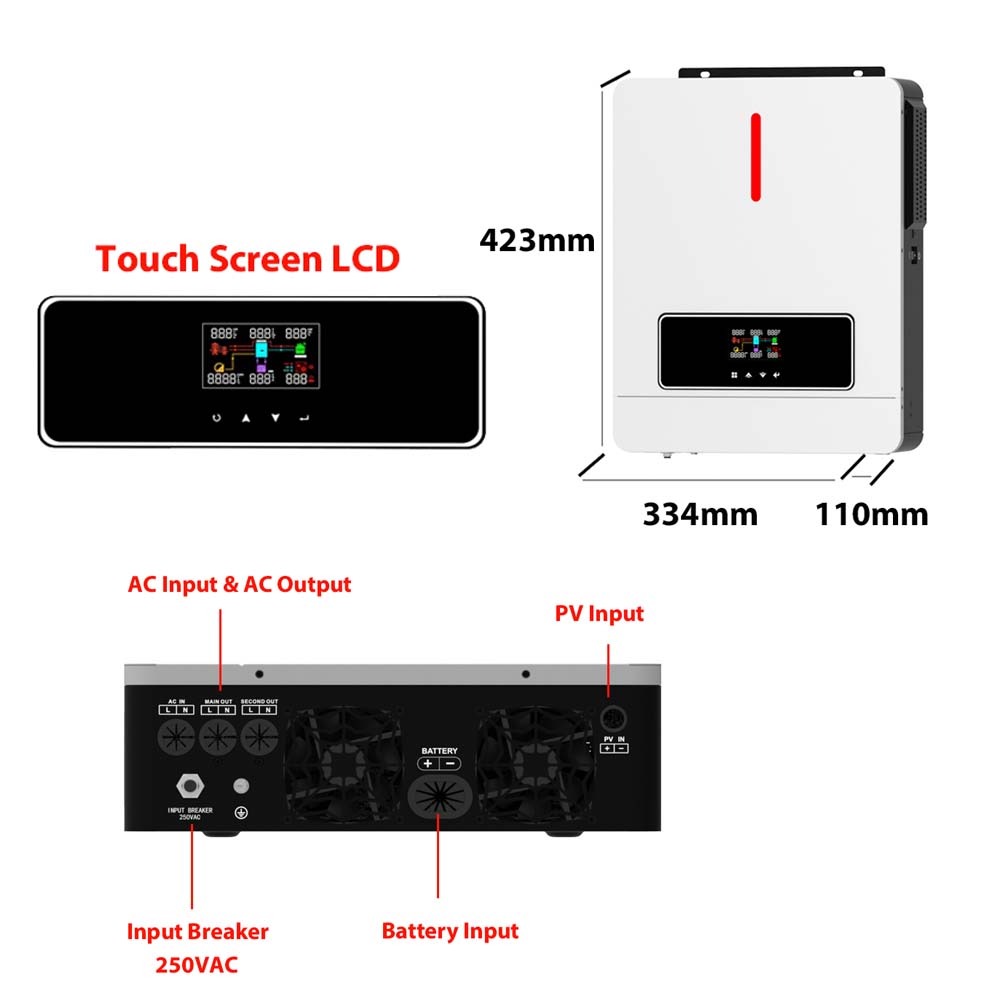
Before purchasing hardware, you must define exactly what you need to keep running. Are you trying to maintain a few essential circuits like refrigeration, internet routers, and basic lighting? Or do you need to operate heavy inductive loads such as HVAC units, well pumps, and air compressors? Clarifying your actual energy demands dictates your entire system architecture. Heavy inductive loads require massive starting currents. Essential circuits require steady, low-level power over extended periods.
Many property owners initially request full whole-home backup. We often have to address this misconception transparently. True whole-house backup demands an extreme battery bank size. It also requires high-amperage inverter stacking to handle simultaneous appliance usage. If your central air conditioner and your electric oven start at the same time during an outage, the surge will easily trip a standard inverter. Achieving whole-home resilience significantly increases upfront investment and complexity.
Routing specific, carefully selected circuits through a sub-panel represents the most reliable deployment method. You connect this sub-panel directly to the Emergency Power Supply (EPS) port of a hybrid grid solar inverter. This approach prevents accidental system crashes. It also maximizes your battery lifespan during prolonged outages.
Your power requirements will likely increase over time. You might purchase an electric vehicle or add a heat pump. Evaluate whether your chosen inverter allows for parallel stacking. Parallel capabilities let you wire multiple inverters together to double or triple your off-grid power output without replacing the original hardware.
You must differentiate between an inverter's nominal continuous output and its surge capacity. Nominal output dictates how many devices you can run simultaneously over hours. Surge output handles brief, high-draw startup currents, commonly known as Locked Rotor Amps (LRA). When a refrigerator compressor kicks on, it can draw three to five times its running wattage for a fraction of a second. If your inverter cannot handle this LRA spike, the entire system will shut down in self-defense.
Unbalanced loads present a major point of failure in cheaper hardware. In North America, split-phase systems operate on two 120V legs to provide 240V power. A reliable backup load solar inverter handles asymmetrical loads efficiently. If you draw 3,000 watts on Leg 1 and only 500 watts on Leg 2, the inverter must balance the voltage dynamically. Inferior units struggle with this imbalance, leading to voltage drops and damaged appliances.
During normal utility operation, grid power passes through the inverter to your critical load panel. The inverter contains internal relays with strict maximum AC current limits. If the inverter features a 40-amp pass-through limit, you cannot install a 100-amp sub-panel behind it. Exceeding this limit will melt the internal contactors. Always verify this bottleneck before finalizing your electrical line diagram.
Accurate battery management guarantees system longevity. You need closed-loop communication between the inverter and the battery bank. The Battery Management System (BMS) transmits precise State of Charge (SOC) data to the inverter via CAN bus or RS485 cables. If you rely on basic voltage-based monitoring, you risk over-discharging lithium batteries. Closed-loop systems gracefully throttle power as the battery nears empty.
| System Architecture | Anti-Islanding | Backup Output Type | BMS Communication | Best Application |
|---|---|---|---|---|
| Standard Grid-Tied | Yes | None | N/A | Reducing utility bills without blackout protection |
| Dedicated Off-Grid | N/A | Grid-Forming | Required | Remote cabins without utility access |
| Hybrid EPS Architecture | Yes | Seamless Transfer (ATS) | Required | Residential backup with solar charging |
Improper neutral-ground bonding acts as the most common pitfall for installers and DIY enthusiasts alike. Electrical codes dictate that neutral and ground should only bond at one single location in the main service panel. However, when the grid drops, the inverter acts as the new power source. It must establish a dynamic neutral-ground bond internally. If it fails to do so, your sub-panel loses its safe path to ground. Always check if your selected on off grid inverter handles neutral switching dynamically.
Passing local electrical inspections requires strict adherence to the National Electrical Code (NEC). Inspectors look for proper breaker interlocks, clearly labeled disconnect placements, and correct wire sizing. Your backup sub-panel must feature warning placards indicating multiple power sources. Skipping these regulatory steps risks severe fines, denied permits, and catastrophic fire hazards.
Many property owners add gas or propane generators to supplement their solar batteries during winter. Integrating a generator introduces significant electrical complexities. Cheaper generators produce "dirty power" with unstable frequencies. The inverter might reject this input to protect your batteries. Furthermore, frequency shifting limits and two-wire auto-start compatibility vary wildly between brands. Always verify generator compatibility before finalizing your schematic.
Extreme ambient temperatures reduce the active power output capability of all power electronics. This phenomenon is known as thermal derating. If an inverter claims a 6,000-watt continuous output at 25°C, it might only provide 4,000 watts at 45°C. You must place the hardware strategically. Install the equipment in a shaded, well-ventilated area—such as a conditioned garage or basement—to prevent overheating during critical summer blackouts.
The energy market currently splits between open-protocol systems and proprietary ecosystems. Walled gardens force you to buy solar panels, inverters, and batteries from a single manufacturer. They offer seamless app integration but severely limit your future upgrade options. Open-protocol inverters accept various 48V server-rack batteries. This hardware agnosticism prevents vendor lock-in and allows you to source high-quality components from multiple trusted brands.
Advanced load management separates premium hardware from budget models. Look for systems featuring smart-load ports, often labeled as "Aux ports". These programmable terminals can automatically drop non-essential loads. If your battery capacity drops below a set threshold, the inverter cuts power to the electric water heater. This load shedding preserves your remaining battery life for the refrigerator and medical devices.
Do not judge a unit solely by its peak wattage numbers. You must evaluate the historical reliability of the brand. Consider the availability of replacement parts in your specific region. Read the fine print on the warranty regarding heavy cycling. Some manufacturers void warranties if the system operates entirely off-grid for extended periods. Ensure the SLA matches your intended daily usage.
Follow this checklist to finalize your project planning:
Maintaining reliable backup circuits requires strict attention to electrical isolation, accurate load mapping, and adherence to grounding safety codes. You cannot simply attach a massive battery to an existing grid-tied system. Instead, you must carefully segment your critical appliances from heavy inductive loads. By building a sub-panel architecture, you ensure your essential devices outlast prolonged grid failures.
An advanced solar backup system serves as the central brain of your resilient home or business. Choosing the right equipment requires prioritizing surge capacity, ATS transition reliability, and code compliance over simple peak wattage marketing numbers. Protect your family and your property by investing in hardware designed for dynamic isolation and split-phase balancing.
Take the next step toward energy independence today. Consult a technical sizing calculator to map your exact wattage requirements. Book a consultation with a certified installer to review your main electrical panel, or dive into a detailed product comparison chart to find the perfect equipment for your specific load profile.
A: Yes. Modern hybrid systems manage this seamlessly. The inverter connects to the utility grid through its AC input while routing power to a dedicated sub-panel via its EPS output. During normal operation, it passes utility power through. When the grid fails, internal relays immediately disconnect the utility input. This prevents lethal back-feeding while keeping your backup panel energized.
A: No. Standard grid-tied systems must shut down during outages to protect utility workers. Without a battery, they cannot form a stable micro-grid. Hybrid inverters require at least a minimal battery buffer to establish the correct voltage and frequency. The battery absorbs sudden load spikes and stabilizes the solar production fluctuations.
A: A grid-tied inverter with backup synchronizes with the utility to sell excess solar power back to the grid. It requires strict anti-islanding certifications. A purely off-grid inverter never connects to the utility. It lacks the hardware to export power and relies entirely on solar, batteries, and generators to form its own isolated electrical network.
A: A neutral fault typically stems from a double-bonded neutral. The code requires neutral and ground to bond only at the main service panel. If your sub-panel also bonds them, current will travel on the ground wire, creating a severe shock hazard. You must isolate the neutral bar in the sub-panel. Always hire a licensed professional electrician to diagnose and fix grounding issues.