
 English


Views: 0 Author: Site Editor Publish Time: 2026-09-02 Origin: Site


Off-grid system failures often stem from a fundamental mismatch between your daily load requirements and the baseline voltage of your battery bank. When you attempt to pull high wattage from a low-voltage battery bank, the system compensates by drawing excessive amperage. This physical reality leads to severe voltage drop, massive thermal losses, and premature hardware failure across your entire power setup. Selecting the correct battery voltage—whether 12V, 24V, or 48V—is the foundational step that dictates the sizing, efficiency, and safety of your power architecture. It determines cable thickness, overcurrent protection limits, and expansion potential. A well-planned voltage baseline ensures your Off Grid Solar Inverter operates within its optimal thermal window. We will break down how to match your specific power demands to the correct voltage tier, avoiding dangerous wiring configurations and hardware bottlenecks.
System efficiency depends heavily on minimizing power loss between the battery bank and the AC output panel. A successful off-grid electrical system maintains stable voltage even under heavy surge loads. When you turn on a heavy appliance, the sudden demand pulls massive energy from the batteries. If the baseline voltage is too low, the system struggles to deliver the required power efficiently. This struggle manifests as heat, voltage sag, and eventual system shutdowns. You must design the architecture to move energy with minimal resistance.
Ohm’s Law and thermal dynamics dictate how power moves through your system. The mathematical relationship is simple: Watts equals Volts multiplied by Amps (W = V x A). If you need 4,800 watts of power, a 12V battery bank must push 400 amps. Doubling the voltage to 24V drops the current to 200 amps. Pushing the system to 48V reduces the current to just 100 amps. Lower amperage directly reduces heat generation within the cables. It also minimizes resistance losses, ensuring more stored energy actually reaches your appliances instead of warming up your wiring compartment.
Let's look at a practical breakdown of how amperage scales with voltage for various standard loads. Notice how quickly the amperage becomes unmanageable at lower voltages.
| Load Requirement | 12V System Amperage | 24V System Amperage | 48V System Amperage |
|---|---|---|---|
| 1,000 Watts | 83.3 Amps | 41.6 Amps | 20.8 Amps |
| 3,000 Watts | 250.0 Amps | 125.0 Amps | 62.5 Amps |
| 5,000 Watts | 416.6 Amps | 208.3 Amps | 104.1 Amps |
| 8,000 Watts | Not Recommended | 333.3 Amps | 166.6 Amps |
These dynamics heavily influence the performance of your inversion equipment. An off grid inverter charger bridges the gap between DC storage and AC consumption. These units manage the inversion of DC power to AC loads while simultaneously handling the charging of the battery bank from backup generators. The baseline voltage dictates the efficiency of both cycles. High amperage during inversion stresses the internal FETs and transformers. High amperage during generator charging stresses the internal rectifier. Matching a high-capacity unit with a high-voltage battery bank ensures smooth, cool operation across all charging and discharging phases.
To ensure your system meets baseline performance standards, evaluate these three success criteria:
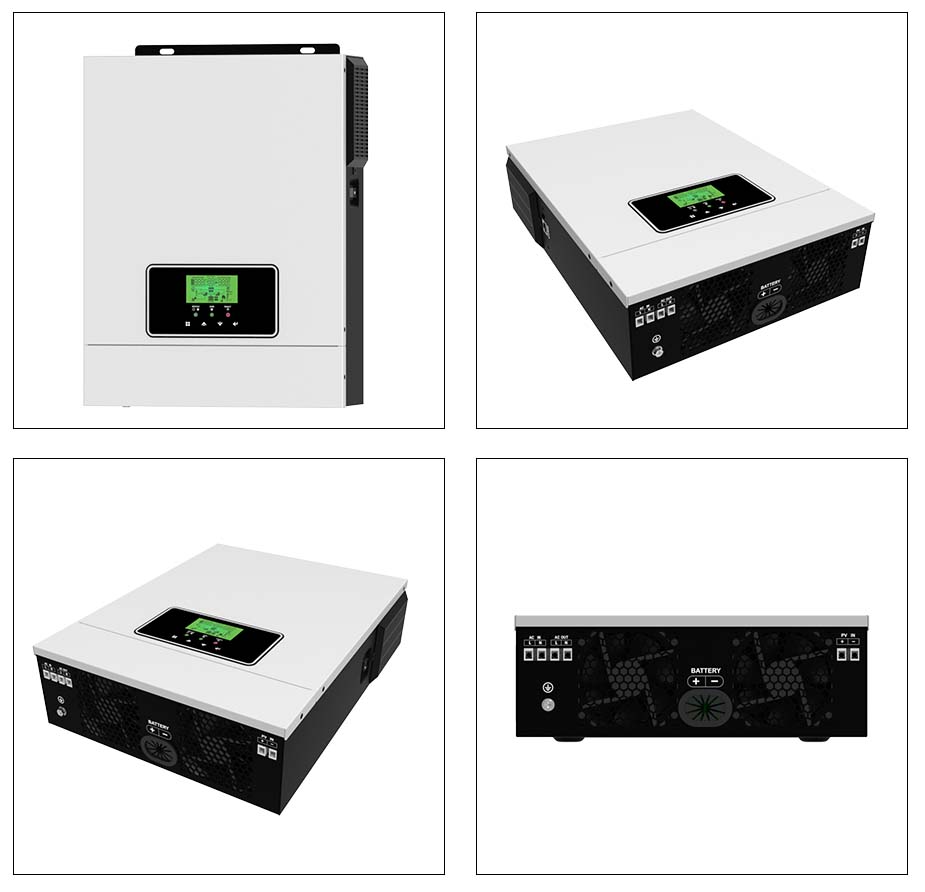
Choosing a battery voltage is a strict engineering decision based on your continuous load and surge requirements. The industry categorizes off-grid battery voltage into three standard tiers. Each tier serves a specific use case with distinct advantages and hard limitations.
The 12V tier remains the standard for mobile applications and micro-setups. Ideal use cases include RVs, camper vans, garden sheds, and small telecommunications nodes. These systems typically handle under 2,000 watts of continuous AC load. You will rarely see a 12V system powering heavy household infrastructure.
The primary advantage of a 12V system is the massive availability of native 12V DC appliances. Users can run low-power DC loads like LED lighting, ventilation fans, or RV water pumps directly from the battery bank. This bypasses the inversion process entirely, eliminating tare losses. The entry barrier for 12V components is generally lower, making it accessible for weekend projects and small mobile builds.
However, 12V systems suffer from severe amperage bottlenecks. Pulling 2,000 watts from a 12V bank requires over 160 amps of current. Running 250 amps for a slightly larger load requires 4/0 AWG copper wire. This wire is nearly an inch thick, incredibly stiff, and expensive. Trying to bend 4/0 cable around tight corners in a camper van battery compartment is physically difficult. High amperage also causes significant voltage drop over short distances. This drop can trigger low-voltage disconnects on your equipment even when the batteries are fully charged.
The 24V tier serves as the bridge between mobile setups and full residential power. Ideal use cases include small off-grid cabins, tiny homes, and remote workshops. These environments typically demand between 2,000 and 4,000 watts of continuous power. A 24V system easily runs a 1/2 HP well pump, a standard residential refrigerator, and a microwave simultaneously. It strikes a balance, allowing you to use 2 AWG or 1/0 AWG wire, which is much easier to terminate and route.
Moving to 24V halves the amperage compared to a 12V setup. This reduction allows for more efficient solar charge controller sizing. A single 60-amp MPPT controller can process roughly 800 watts of solar at 12V, but it can handle 1,600 watts at 24V. This saves significant space on your power wall. It also allows for longer cable runs between the battery bank and the inverter without suffering severe voltage drop. It serves as a solid baseline strategy for users running medium loads.
The limitation of 24V is its nature as a stepping stone. It can become a dead-end if you eventually decide to expand your infrastructure. If you want to power heavy 240V appliances like deep-well pumps, electric ranges, or central air conditioners, 24V will struggle. The amperage climbs too high for standard components, forcing you into specialized hardware.
The 48V tier is the undisputed baseline for full-time residential properties. If you require a heavy-duty home off grid power inverter, you must build a 48V architecture. These systems easily handle 5,000 to 15,000+ watts of continuous load, powering modern homes without compromise. Most modern homes require 240V split-phase power to run central air conditioning, electric dryers, and deep well pumps. 48V inverters are natively designed to stack together or output 240V directly, providing the massive surge capacity needed for these heavy inductive loads.
This voltage provides maximum efficiency for high-draw appliances. It keeps amperage incredibly low. For example, pulling 5,000 watts at 48V draws roughly 104 amps. This allows you to use standard, manageable wire sizes like 2 AWG or 1/0 AWG. It also allows for safer DC breaker integration. High-capacity charge controllers can process massive solar arrays at 48V, often handling over 4,000 watts per controller. This drastically reduces the number of components needed on your power wall.
Building a 48V battery bank requires a higher initial investment in lithium cells or lead-acid blocks. You also need specialized high-voltage DC safety equipment. DC breakers and fuses rated for 48V systems are strictly required to prevent arc flashes, adding to the upfront installation complexity.
Evaluating inverter specifications requires a clear understanding of how your chosen voltage impacts performance. You must look beyond the marketing numbers and analyze how the unit handles real-world electrical stress.
Your system must handle both continuous running watts and instantaneous surge watts. Inductive loads like air conditioner compressors, well pumps, and heavy motors require a massive spike in power to start. This is known as Locked Rotor Amps (LRA). You must audit these starting watts carefully.
Ensure the inverter's DC input voltage can handle this sudden amperage spike without tripping low-voltage disconnects. A 12V system will experience a severe voltage sag during a heavy motor start. The inverter senses this sag and shuts down to protect itself. A 48V system absorbs this surge much better. The higher voltage maintains stability, allowing the inverter to push the necessary AC current to start the compressor without collapsing the DC bus.
When auditing your surge requirements, follow these steps:
Inverters consume power simply by being turned on. This is called idle power consumption or tare loss. Larger 48V inverters, especially low-frequency models with massive copper transformers, have higher idle consumption than small 12V units. A heavy-duty 48V unit might consume 50 to 100 watts continuously just to keep the AC panel energized.
This trade-off is necessary for whole-home capacity. The internal components required to surge a well pump inherently require more energy to stay magnetized. You must account for this tare loss in your daily energy calculations. If your cabin sits empty for weeks, a large 48V inverter will drain the battery bank faster than a small 12V unit unless you turn it off or maintain a steady solar charge.
You must distinguish between PV string voltage and battery voltage. Modern solar panels are rarely wired in parallel to match the battery. Instead, they are wired in series to create high-voltage strings. These strings often run between 150V and 600V DC. High voltage keeps the PV amperage down, allowing you to use standard 10 AWG solar wire for long runs from the roof to the power room.
The MPPT charge controller takes this high-voltage solar energy and steps it down to match your battery bank. A 48V battery bank allows the controller to process significantly more total solar wattage from these high-voltage strings. This reduces the number of parallel strings required, eliminates the need for complex combiner boxes, and maximizes the efficiency of the step-down conversion process.
| Charge Controller Rating | Max Solar Input at 12V | Max Solar Input at 24V | Max Solar Input at 48V |
|---|---|---|---|
| 40 Amp MPPT | 500 Watts | 1,000 Watts | 2,000 Watts |
| 60 Amp MPPT | 800 Watts | 1,600 Watts | 3,200 Watts |
| 80 Amp MPPT | 1,000 Watts | 2,000 Watts | 4,000 Watts |
| 100 Amp MPPT | 1,200 Watts | 2,400 Watts | 4,800 Watts |
Designing an off-grid architecture carries inherent physical risks. Mistakes in voltage selection often lead to severe safety hazards and expensive hardware replacements.
Many novices attempt to run high-capacity inverters on low-voltage battery banks to save money on batteries. Trying to run a 5,000W+ off grid solar inverter on a 12V battery bank creates severe fire risks. The system will demand over 400 amps of continuous current. Standard battery terminals are not designed to handle this thermal load. The connections will heat up, oxidize, and eventually melt. Hardware degradation accelerates rapidly under these conditions, voiding warranties and threatening the physical structure of your home.
Lead-acid batteries experience significant voltage sag under heavy load compared to lithium iron phosphate batteries. If you run a high-draw appliance on a 12V lead-acid bank, the voltage might temporarily drop from 12.6V to 10.5V. This sudden drop often triggers the inverter's low-voltage alarm, causing nuisance shutdowns. Upgrading to a 48V lithium architecture virtually eliminates this issue. Lithium cells maintain a flat voltage curve, and the 48V baseline ensures the amperage remains low enough to prevent severe sag at the battery terminals.
Inverters and DC breakers are strictly voltage-specific. A 12V inverter cannot be reprogrammed to accept 48V. Failing to future-proof your system carries a heavy financial penalty. If you start at 12V and later decide to upgrade to 48V to run an air conditioner, you must completely replace the inverter. You must also replace the solar charge controllers, buy new DC breakers, and completely reconfigure the battery bank. Always plan for your 5-year load projection, not just your current weekend needs.
National Electrical Code considerations for DC wiring are strict. DC current does not cross zero like AC current, making DC arcs extremely difficult to extinguish. You must use properly rated DC breakers. High-amperage lithium battery banks require Class T fuses. Lithium batteries can discharge thousands of amps instantly during a dead short. Standard ANL or MEGA fuses will arc over and fail to stop the current. Class T fuses have the necessary interrupt rating to stop a catastrophic lithium short circuit.
Keep these compliance and safety standards in mind:
Finalizing your off-grid power architecture requires matching your daily energy consumption with the correct battery voltage. Selecting the right voltage tier prevents thermal bottlenecks, reduces cable sizing, and ensures your inversion equipment operates safely under heavy loads.
Take these immediate steps to finalize your system design:
A: No. Inverters have strict DC input voltage windows. A 48V inverter will not power on or function with a 24V battery bank. The internal components are physically wound and programmed to accept a specific voltage range. You must match the battery bank voltage exactly to the inverter's rated input.
A: Manufacturers use 48V to manage amperage. A 10,000W inverter running at 12V would draw over 800 amps. This level of current is impractical and highly unsafe for standard wiring, terminals, and breakers. Using 48V keeps the amperage low, reducing heat and allowing for standard, safe electrical components.
A: Yes. The unit requires a matched battery bank to both draw DC power for inversion and supply DC power for charging when connected to an AC generator. The internal circuitry uses the same DC bus for both the inversion and rectification processes.
A: Native 48V rack-mount server batteries are generally superior. They offer built-in BMS monitoring optimized for 48V inverters. Wiring 12V batteries in series requires strict cell balancing. If one 12V block degrades, it bottlenecks the entire 48V string, leading to system instability and reduced capacity.
A: Higher battery voltages allow a single charge controller to process more total solar wattage. A 60-amp MPPT controller can handle roughly 800W of solar input at 12V, but it can process over 3,200W at 48V. This drastically reduces the number of controllers needed for large arrays.
A: The inverter will hit its Low Voltage Disconnect (LVD) threshold and shut down automatically. This safety mechanism protects the battery bank from over-discharge and permanent chemical damage. The inverter will remain off until the battery voltage rises back to a safe reconnect threshold.