
 English


Views: 0 Author: Site Editor Publish Time: 2026-10-16 Origin: Site


Picture this scenario. You are midway through a crucial remote meeting. Perhaps you are preparing dinner for your family. Suddenly, the grid goes dark. The familiar hum of your refrigerator stops. Your Wi-Fi drops immediately. Are you tired of unexpected power outages disrupting your daily life?
Installing solar panels is a fantastic leap toward sustainability. However, panels alone cannot keep your lights on when the utility grid fails. Finding a reliable battery brand to bridge this gap is often a tough engineering challenge. This is especially true with hundreds of manufacturers currently flooding the renewable energy sector.
In this comprehensive guide, we will evaluate the top 5 energy storage company profiles dominating the market today. We will break down their core technologies. We will evaluate their distinct engineering approaches. Finally, we will help you choose the exact system that fits your household's unique electrical demands.
Before diving into specific manufacturers, we must understand the macroeconomic forces shaping the battery market. Recent market analyses reveal a massive shift toward decentralized energy grids. Utility companies are aggressively hiking Time-of-Use rates. Aging electrical infrastructures struggle to cope with extreme weather events. Consequently, market experts note that residential battery adoption is skyrocketing.
Furthermore, the stabilization of raw lithium carbonate costs has profoundly impacted the industry. Premium, high-capacity setups are now far more accessible to the average homeowner than they were just three years ago. Consumers are no longer just buying batteries for emergency blackouts. They are investing in them as proactive financial tools to manipulate utility billing cycles.
Transitioning to renewable energy is only the first step toward a sustainable future. Effectively capturing and storing that generated power is where true efficiency and Return on Investment lie. A dedicated energy storage unit is no longer a luxury. It has evolved into a critical component of modern household infrastructure.
Achieving True Energy Independence
The primary function of your battery bank is to capture excess electricity generated by your solar array during peak daylight hours. Without a physical battery, this surplus energy is often sent back to the grid. Sometimes, utility companies offer minimal financial compensation for this power. A quality storage unit allows you to retain this power. It grants you the independence to run your household at night or during heavy rainstorms without relying on external utility providers.
Financial Savings and Peak Shaving
Utility providers increasingly utilize variable pricing models. They charge exorbitant rates during evening hours when neighborhood grid demand peaks. A strategically deployed battery enables a technique known as peak shaving. Specifically, your home automatically switches to stored battery power during the most expensive billing windows. This drastically slashes your monthly electricity costs. Over a typical ten-year lifespan, these cumulative daily savings frequently offset the initial hardware investment.
Uncompromising Grid Resilience
Aging transformers, severe storms, and rolling blackouts pose significant risks to your continuous power supply. Having a robust backup configuration ensures that your critical loads remain fully operational during catastrophic grid failures. This includes deep freezers, medical continuous positive airway pressure machines, and communication devices. Buying from a top-tier brand guarantees safer chemical compositions, reliable firmware updates, and comprehensive warranties.
With countless new brands entering the renewable sector, evaluating them requires strict, objective criteria. As frontline engineers, we analyze extensive performance data based on the following critical metrics to identify true industry leaders.
Battery Chemistry and Operational Safety
Not all power cells are created equal. The industry is rapidly migrating away from volatile Nickel Manganese Cobalt and outdated lead-acid variants. Today, Lithium Iron Phosphate is the undisputed champion. This superior chemistry offers unmatched thermal stability. It is highly resistant to overheating and thermal runaway. When evaluating a lithium battery energy storage system, safety certifications like UL 1973 and UL 9540 act as mandatory benchmarks for any reputable company.
System Integration and Installation Complexity
Component mismatch remains a common point of failure in piecemeal solar setups. The leading brands now engineer holistic packages. They consolidate the battery modules, the inverter, and the energy management software into a single, cohesive unit. This tight integration guarantees seamless communication between internal components. It also drastically slashes the hours required for mounting and wiring.
Warranty Backing and Customer Support
A standard industry warranty covers ten years or a specific energy throughput limit. The total energy cycled through the unit over its lifespan dictates this limit. The most confident manufacturers offer guarantees of 6,000 to 10,000 charge cycles. They also promise the unit will maintain at least seventy percent of its original capacity. Responsive technical service is vital for long-term peace of mind.
Modular Scalability
Your household's electrical demands will inevitably change over time. You might purchase a new electric vehicle, add a hot tub, or expand your home's square footage. A premium setup must be modular. Scalability allows users to start with a modest baseline capacity, such as a 5 kilowatt-hour unit. You can then effortlessly stack additional modules later without requiring a complete, expensive system overhaul.
| Feature | Lithium Iron Phosphate | Nickel Manganese Cobalt | Traditional Lead-Acid |
|---|---|---|---|
| Safety and Thermal Stability | Excellent. Extremely low risk of fire. | Moderate. Requires strict liquid cooling. | Good. Emits hazardous gases during charging. |
| Expected Cycle Life | 6,000 to 10,000 cycles. | 3,000 to 5,000 cycles. | 500 to 1,000 cycles. |
| Usable Depth of Discharge | Up to 95 to 100 percent. | Up to 90 percent. | Maximum 50 percent. |
| Routine Maintenance | Zero maintenance required. | Zero maintenance required. | Regular watering and terminal checks required. |
Based on our rigorous engineering framework, here is an in-depth review of the top five manufacturing archetypes currently dominating the residential and commercial markets. We will highlight why the all-in-one approach ultimately provides the best value.
Many homeowners look toward brands that originated in the electric vehicle space. These manufacturers offer sleek designs and strong brand recognition. Their products utilize an Alternating Current coupled architecture designed for easy retrofitting. However, their reliance on Nickel Manganese Cobalt chemistry often means a lower thermal threshold compared to dedicated solar storage brands. Furthermore, high consumer demand frequently leads to premium pricing and frustratingly long wait times for installation.
Another major segment includes massive global battery cell manufacturers. These companies boast vertically integrated supply chains and provide highly competitive pricing on raw battery modules. The downside is that they usually only supply the battery box. You are forced to pair their unit with a compatible third-party inverter. From an engineering standpoint, mixing component brands significantly complicates the wiring process and increases the risk of communication faults.
Certain companies dominate the microinverter ecosystem. Their batteries are purpose-built to integrate flawlessly with their own roof-mounted microinverters. This distributed architecture offers unmatched reliability. If one panel goes down, the rest keep producing. Yet, attempting to mix these specific batteries with standard string inverters from competing brands causes severe technical headaches and major efficiency losses.
European engineering brands often focus on intelligent energy management and Virtual Power Plant integration. They treat the battery as a smart node on the grid. Their predictive software can optimize charging cycles based on local weather patterns. However, these systems sit at the absolute highest end of the price spectrum. The steep premium cost extends the financial payback period significantly for the average homeowner.
Finally, we have the manufacturers focused entirely on holistic integration. NextPower Solar stands out as the premium choice in this category. By engineering the battery modules, the inverter, and the management software into a single cohesive unit, they completely eliminate component mismatch.
Their flagship products utilize top-tier Lithium Iron Phosphate chemistry for maximum fire safety. Because they focus exclusively on tightly integrated packages, their all in one energy storage system operates flawlessly right out of the box. This plug-and-play architecture slashes electrician labor fees, making it highly adaptable for both modest suburban homes and sprawling estates.
To make a truly informed purchasing decision, buyers must look past the sleek exterior. You must understand the internal components you are paying for. A modern storage unit is much more than just a heavy box of batteries. It is a highly sophisticated electronic ecosystem.
The Superiority of Advanced Lithium
The foundational core of any modern setup relies on advanced lithium cells. Legacy lead-acid batteries can only be discharged to fifty percent of their capacity before suffering permanent chemical damage. In contrast, modern Lithium Iron Phosphate batteries boast a Depth of Discharge of up to one hundred percent. This means you actually get to use nearly all the energy you store. These cells routinely endure over 6,000 cycles, translating to over fifteen years of grueling daily use with zero physical maintenance.
The Role of Advanced Conversion Hardware
Solar panels generate Direct Current electricity. Your household appliances require Alternating Current to function. A hybrid solar inverter goes a massive step beyond basic conversion. It intelligently manages multiple power flows at once. It converts Direct Current from the roof to Alternating Current for the living room, while simultaneously managing the delicate charging of the battery bank.
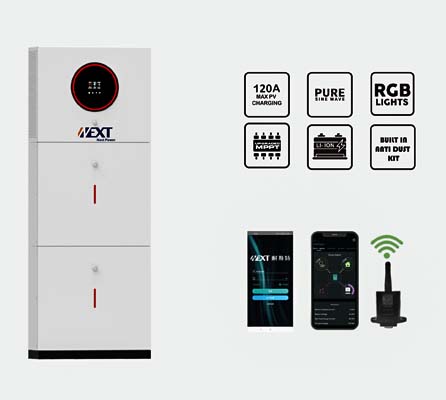
For instance, NextPower’s VICTOR NM ESS series offers pure sine wave output options of 4.2 kilowatts, 6.2 kilowatts, and 10.2 kilowatts. It features a built-in 100 Ampere MPPT solar charge controller and supports a maximum PV input voltage of 500 Volts Direct Current. This level of integrated engineering minimizes energy conversion losses and delivers industrial-grade reliability to the residential market.
Intelligent Battery Management Systems
The unsung hero operating behind the scenes is the Battery Management System. This highly intelligent circuit board micro-manages the voltage, current, and temperature of every single individual cell inside the metal casing. It actively prevents overcharging, deep discharging, and dangerous overheating. If it detects even a minor anomaly, it will automatically isolate the system to prevent damage. This ensures absolute, uncompromising safety for your family.
Energy storage solutions are engineered vastly differently depending on the scale of the intended application. Understanding this distinction ensures you do not overpay for unnecessary industrial capacity or accidentally under-size your residential system.
Residential Applications
Systems built for residential use typically range from 5 to 20 kilowatt-hours in total capacity. The engineering focus here is heavily placed on visual aesthetics, space-saving footprints, and whisper-quiet operation. A standard home energy storage unit is perfectly calibrated to handle typical household loads. It keeps the refrigerator cold, powers the router, keeps the lights on, and manages localized air conditioning zones during peak evening hours. The best residential systems prioritize user-friendly mobile apps and modular designs.
Commercial and Industrial Storage
In contrast, commercial systems are vastly larger. They often start at a baseline of 50 kilowatt-hours and easily scale into the Megawatt-hour range. These robust, heavy-duty units are built for grueling operations. They power heavy manufacturing machinery, support massive server farms, and provide large-scale grid stabilization. They prioritize raw, brute-force output and heavy-duty liquid cooling mechanisms over visual aesthetics.
When evaluating the current market for a solution that perfectly balances premium commercial-grade technology with everyday user convenience, the NextPower VICTOR ESS Series emerges as a clear frontrunner. This system is meticulously engineered to eliminate the common pain points associated with traditional piecemeal installations.
Seamless Factory Integration
The VICTOR ESS Series functions as a true, factory-integrated powerhouse. It houses the high-density Lithium Iron Phosphate battery modules, the advanced hybrid inverter, and the intelligent management board within a single enclosure. It completely eliminates the need for messy external wiring. This plug-and-play architecture not only looks incredibly clean on a garage wall but also ensures maximum energy conversion efficiency.
Unmatched Outage Reliability
When the utility grid fails, response time is everything. The VICTOR ESS Series is designed to operate as a highly responsive solar backup power system. It features an ultra-fast transfer switch that detects grid outages in mere milliseconds. It seamlessly transitions your home to battery power so quickly that your digital clocks will not even blink. This ensures that sensitive electronics remain entirely uninterrupted during sudden rolling blackouts.
User-Friendly Global Monitoring
Top-tier hardware is only as good as the software that controls it. The VICTOR ESS Series includes smart, real-time monitoring accessible via a sleek mobile application. Homeowners can track their exact solar production, monitor the battery state-of-charge, and audit their home's real-time energy consumption from anywhere in the world.
Selecting the right hardware for your residence requires a methodical, data-driven approach. Relying on guesswork can lead to underperforming setups or unnecessary expenditures. To ensure your investment yields the highest possible return, follow this actionable, objective engineering framework.
The foundation of any successful installation is an accurate energy audit. An undersized system will fail to provide adequate power during a blackout. An oversized system will unnecessarily extend your financial payback period.
To calculate your baseline energy needs, follow these practical steps:
| Household Size | Square Footage | Average Daily Usage | Recommended Battery Capacity |
|---|---|---|---|
| Small residence, one to two people | 1,000 to 1,500 square feet | 15 to 20 kilowatt-hours | 10 to 15 kilowatt-hours |
| Medium residence, three to four people | 1,500 to 2,500 square feet | 25 to 30 kilowatt-hours | 20 to 30 kilowatt-hours |
| Large residence, five or more people | Over 2,500 square feet | 40+ kilowatt-hours | 30 to 40+ kilowatt-hours |
Once you understand your total daily usage, you must define the primary purpose of your system. Installations are generally categorized into two distinct operational modes: whole-home backup and critical load backup.
Whole-Home Backup Requirements:
This configuration is designed to power every single circuit in your electrical panel simultaneously. It requires massive storage capacity and a high continuous power output to handle the intense surge currents of heavy appliances like central air conditioners and electric water heaters. Because of the extreme hardware requirements, whole-home backup is significantly more expensive.
Critical Load Backup Strategy:
A far more cost-effective and common approach is the critical load configuration. In this setup, an electrician installs a dedicated sub-panel containing only your most essential circuits. During a grid failure, the battery will exclusively power these vital appliances. This drastically extends your backup duration. When sizing your setup, you must account for both the starting surge watts and continuous running watts of these essential items.
| Household Appliance | Running Watts Continuous | Starting Watts Surge |
|---|---|---|
| Standard Refrigerator | 300 to 800 watts | 1,200 to 1,500 watts |
| Wi-Fi Router and Modem | 15 to 30 watts | 15 to 30 watts |
| LED Lighting per room | 40 to 60 watts | 40 to 60 watts |
| Kitchen Microwave | 1,000 watts | 1,500 watts |
| Well Water Pump | 1,000 watts | 2,100 watts |
The warranty is the most objective indicator of expected lifespan and manufacturer confidence. Standard industry practice dictates a ten-year warranty, but you must analyze the fine print.
Choosing the right hardware ensures true grid independence and maximizes the financial return on your solar investment. By carefully evaluating your household's specific energy needs, backup goals, and hardware compatibility, you can avoid costly engineering mistakes.
While many global brands offer piecemeal solutions, NextPower’s VICTOR ESS Series provides an unbeatable combination of premium lithium technology, integrated conversion hardware, and effortless scalability. It is purpose-built from the ground up to take the headache out of home energy management.
Ready to take control of your daily energy usage and protect your family from unpredictable blackouts? Visit NextPower Solar today to explore the VICTOR ESS Series. Match your specific household requirements with our advanced product lineup, and step into a future of uninterrupted backup power.
An all-in-one system is a highly integrated piece of hardware that consolidates the essential components of solar storage into a single, compact enclosure. Traditional setups require a disjointed network of separate components. You would have battery modules mounted on a wall, a separate inverter installed nearby, external charge controllers, and complex wiring connecting the management software. By combining these elements, an integrated system drastically reduces installation time and minimizes aesthetic clutter on your property. More importantly, housing the battery cells and the inverter in the same unit reduces the number of external electrical connections. This minimizes the risk of wiring faults, reduces voltage drop across long cables, and improves the overall communication latency between the software and the power delivery hardware.
The operational lifespan is determined by two distinct metrics: calendar life and cycle life. Under normal operating conditions, modern tier-one systems are engineered to last between ten to fifteen years. The industry standard has shifted toward Lithium Iron Phosphate chemistry due to its superior thermal stability and longevity compared to older technologies. A high-quality unit is typically rated for 6,000 to 10,000 charge cycles. If you discharge and recharge it once per day, 6,000 cycles equate to over sixteen years of continuous use. It is important to note that reaching the end of its cycle life does not mean it simply stops working. Rather, it means the maximum storage capacity has degraded to roughly sixty to seventy percent of its original factory rating.
Yes, it can absolutely run an entire household during a grid outage, provided that the system is engineered and sized correctly to meet your specific electrical loads. Running a whole house requires the hardware to meet two critical thresholds. You need sufficient energy capacity to last through the night, and sufficient continuous power output to handle the simultaneous operation of heavy appliances. For standard residential whole-home backup, you generally need a minimum of 20 to 30 kilowatt-hours of storage capacity. This must be paired with inverters capable of delivering 10 to 15 kilowatts of continuous output. If your budget or physical space does not allow for a massive multi-battery array, the recommended alternative is to wire the system to a critical loads panel to ensure essential devices remain operational for days.
If you are planning to install solar panels and battery storage simultaneously, utilizing a hybrid model is highly recommended and represents the most efficient engineering choice. A standard solar inverter only performs one function. It converts the Direct Current electricity generated by your roof panels into Alternating Current electricity for your household appliances. A hybrid version, however, is a bi-directional device that acts as the central brain of a modern energy ecosystem. It intelligently manages multiple power flows simultaneously. It can route Direct Current power directly from the solar panels into the battery for highly efficient charging. It can convert Direct Current to Alternating Current for immediate home consumption. It can even pull Alternating Current power from the utility grid to charge the batteries when electricity rates are low.
Yes, from both a financial and practical engineering standpoint, they are highly worth the investment for most homeowners. The financial return is driven heavily by peak shaving and avoiding high Time-of-Use utility rates. By storing cheap solar power during the day and discharging it during expensive evening hours, the system actively lowers your monthly bill. Additionally, the intangible value of grid resilience cannot be overstated. Protecting your home from rolling blackouts, preserving perishable food, and keeping medical devices running provides immense peace of mind that justifies the initial hardware costs.
Sizing depends entirely on your consumption habits and backup goals. For a basic critical load setup covering just the refrigerator, lights, and internet router, a single 5 to 10 kilowatt-hour battery is often sufficient. However, if you want to run a standard American home normally during an outage, including well pumps and microwaves, you will typically need between 20 and 30 kilowatt-hours of capacity. To determine your exact size, review your monthly utility bill, find your daily average kilowatt-hour usage, and consult with a solar engineer to match that figure with your desired days of backup autonomy.