
 English


Views: 0 Author: Site Editor Publish Time: 2026-10-19 Origin: Site


Does the looming threat of grid instability worry you? Traditional power networks increasingly falter under the weight of extreme weather and surging demand. Relying solely on utility companies is becoming a risky gamble. Today, modern homes and businesses require far more than just a connection to the pole. They need reliable, decentralized electricity generation. In this comprehensive guide, we will navigate the complex world of electrical setups. We will move past outdated infrastructure to explore the ultimate solutions for true power independence.
To make informed decisions about residential or commercial power infrastructure, one must first grasp the fundamental mechanics of an electrical network. At its core, this system is a highly structured framework designed to facilitate the seamless flow of electricity from its point of origin directly to its end use. In the realm of modern technology, it strictly pertains to how we generate, route, and manage power.
Every functional electrical network consists of three primary stages. First is generation, the process of converting primary energy sources into electrical power. Historically, this relied heavily on centralized fossil fuel plants burning coal or natural gas. Today, generation increasingly occurs at the decentralized level through rooftop photovoltaic solar panels and localized wind turbines.
Next comes transmission and distribution. In the traditional utility model, high-voltage lines transport power across vast distances. This inevitably results in significant transmission losses. Finally, we reach consumption and storage. At this stage, power is either immediately utilized by household appliances or banked for future use.
The most profound shift in modern electrical engineering is the rapid transition from centralized, one-way power grids to decentralized, bidirectional microgrids. In the past, consumers were strictly end-users who could only draw power from the utility. Now, property owners can generate their own electricity, store it locally, and even export surplus power back to the grid for financial credit. Naturally, this structural evolution demands advanced management hardware to ensure stability and safety.
When evaluating renewable power setups, the architecture you select ultimately dictates your level of grid reliance, your upfront capital investment, and your protection against blackouts. Electrical energy systems are broadly classified into three primary categories.
| System Type | Grid Reliance | Blackout Protection | Ideal Application |
|---|---|---|---|
| Grid-Tied | High | None | Reducing daytime utility bills on a tight budget. |
| Off-Grid | Zero | Complete | Remote cabins and areas without municipal power access. |
| Hybrid | Low | Excellent | Modern homes needing backup power and peak-rate avoidance. |
Grid-tied setups are the most common entry-level solar installations. In this configuration, solar panels are connected directly to the utility grid via a standard string inverter. When your panels generate more electricity than your home consumes, the excess is sent to the utility grid. This often earns you credits through net metering programs. Conversely, when production drops at night, your home seamlessly draws power from the grid.
The primary advantage here is a lower initial installation cost, as there are no expensive batteries to purchase. However, the critical drawback is vulnerability. Grid-tied systems offer absolutely zero protection during blackouts. For safety reasons, standard grid-tied inverters are mandated to automatically shut down during a power outage to prevent back-feeding live electricity into lines being repaired by utility workers.
At the opposite end of the spectrum, off-grid systems are entirely autonomous. They feature no physical connection to the municipal utility grid. Because there is no external safety net to rely on at night or during prolonged cloudy periods, this architecture depends entirely on a robust combination of solar generation, massive battery banks, and often secondary mechanical backup generators.
While off-grid systems provide total energy independence, they are highly capital-intensive. Designing an off-grid home requires precise load calculation and significant over-sizing of both the solar array and the storage capacity. This guarantees uninterrupted power during worst-case weather scenarios.
For the vast majority of modern property owners, hybrid systems represent the most pragmatic and financially sound approach. A hybrid system remains connected to the utility grid but incorporates localized battery storage for backup. It utilizes intelligent routing to prioritize your home consumption of solar energy, charges batteries with any excess power, and only draws from the grid when absolutely necessary.
Hybrid setups effectively marry the financial benefits of grid-tied systems with the security of off-grid systems. Imagine a severe storm knocks out neighborhood power. Instead of sitting in the dark, your hybrid system automatically isolates your home and continues to supply power from your battery reserves. It keeps your refrigerator running and your lights on without missing a beat.
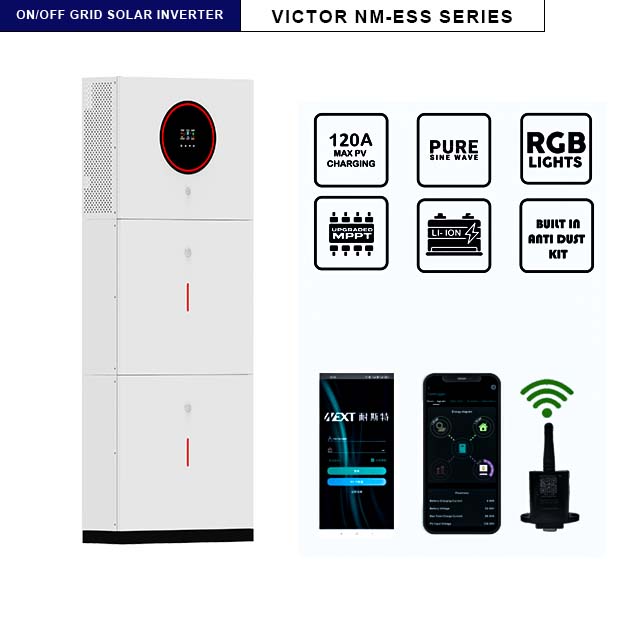
An Energy Storage System is the foundational technology that makes renewable energy truly reliable. By definition, an ESS is a complex network of hardware and software designed to capture electrical energy, store it chemically, and discharge it precisely when needed.
To fully appreciate why an ESS is critical, one must examine the inherent flaw in solar power — intermittency. Solar panels only generate electricity when the sun is shining. This generation curve rarely aligns with actual human consumption patterns. This discrepancy is famously known in the energy sector as the Duck Curve. During midday, solar generation reaches its absolute peak, but household energy consumption is typically at its lowest while occupants are away at work or school. Conversely, in the early evening, solar production plummets to zero just as household energy demand spikes for cooking, heating, and charging electric vehicles.
Without storage, the excess midday power is either entirely wasted or sent back to the grid for a fraction of the retail electricity price. An ESS elegantly solves this curve by acting as a localized reservoir. It captures the midday surplus and holds it until the evening peak. This mechanism not only maximizes the return on investment for your solar panels but also provides critical infrastructure resilience.
Recent energy sector reports highlight a rapid shift in how global infrastructure approaches power management. We are moving away from a reliance on massive, centralized fossil fuel plants toward a distributed energy resource model. Utility operators are increasingly recognizing that updating aging grid infrastructure is far more expensive than incentivizing localized power generation.
A major catalyst for this trend is the steep decline in battery manufacturing costs. This economic shift has made home energy storage accessible to the broader market, rather than just early tech adopters or off-grid enthusiasts. Furthermore, utility companies are beginning to embrace Virtual Power Plants. In a VPP network, thousands of individual residential battery systems are digitally connected. During moments of extreme grid stress, the utility can draw tiny amounts of power from these networked home batteries to stabilize the grid. This transforms the residential battery from a simple backup device into an active, revenue-generating asset.
While the concept of storing energy is straightforward, the underlying technologies vary significantly in chemistry, efficiency, and practical application. The battery chemistry you choose dictates your system efficiency, lifespan, and safety parameters.
For residential and commercial applications, the lithium battery energy storage system has established itself as the undisputed industry standard. Specifically, Lithium Iron Phosphate — often referred to as LiFePO4 — chemistry has overtaken older lithium-ion variants due to its superior safety profile and stationary longevity.
A high-quality lithium setup offers a remarkable depth of discharge of up to 95 percent. This means you can utilize nearly the entire capacity of the battery without degrading its internal structure. Consequently, LiFePO4 batteries consistently deliver over 6,000 charge cycles. For a standard household charging and discharging the battery daily, this translates to a functional lifespan exceeding 15 years. They require absolutely zero active maintenance.
Lead-acid technology has been utilized for over a century and represents the older generation of energy storage. While these batteries boast a much lower upfront purchase price, they present significant operational limitations for modern homes.
Crucially, lead-acid batteries generally restrict depth of discharge to just 50 percent. Discharging them deeper causes permanent damage to the battery plates. Therefore, a 10kWh lead-acid bank only provides 5kWh of usable energy. They are exceptionally heavy, demand vast amounts of physical space, and often require regular maintenance like equalizing charges and watering. Over a decade, the frequent replacement costs of lead-acid batteries almost always surpass the initial investment of a premium lithium system.
Transitioning to a decentralized power model requires highly specific hardware. A robust residential setup is not merely a box of batteries. It is a synchronized network of specialized components designed to manage voltage, route power, and communicate flawlessly with the utility grid.
The battery bank is the physical collection of cells that store electrical energy in direct current form. The capacity of the bank, measured in kilowatt-hours, determines exactly how long your property can operate during an outage. Modern battery banks feature modular designs. This allows property owners to start small and seamlessly stack multiple units in parallel to increase total storage capacity as their family energy needs grow.
Because solar panels generate direct current and batteries store direct current, but household appliances operate on alternating current, a conversion mechanism is mandatory. The hybrid solar inverter serves as the computational brain responsible for this vital task.
Unlike standard string inverters that only push power in one direction, a hybrid inverter is capable of complex bidirectional power management. For example, a robust 3.6KW to 5KW hybrid inverter simultaneously manages the input from the solar array, routes it to charge the battery bank, converts it to power your television, and manages the connection to the municipal grid. It ensures that the transition between grid power and battery backup occurs in mere milliseconds.
Historically, installing solar storage meant mounting a separate inverter, charge controller, battery bank, and complex wiring conduits across a garage wall. This fragmented approach is incredibly labor-intensive, occupies significant wall space, and introduces multiple points of potential hardware failure.
The modern engineering solution is the all in one energy storage system. These unified units house the high-efficiency lithium battery modules, the hybrid inverter, and the sophisticated Battery Management System within a single streamlined chassis. By eliminating external wiring and separate enclosures, these plug-and-play designs drastically reduce the labor hours required by certified electricians.
The decision to invest in decentralized energy storage is no longer driven solely by environmental consciousness. It is increasingly a matter of risk mitigation and financial optimization. The traditional utility model is facing unprecedented strain, making localized power generation a logical protective measure.
First and foremost is the reality of grid vulnerability. Aging utility infrastructure is struggling to cope with extreme weather events. Imagine a sweltering summer afternoon when the grid suddenly fails. Without warning, your air conditioning halts, and the food in your refrigerator begins to spoil. A solar backup power system functions as a whole-house uninterruptible power supply. When grid voltage drops to zero, the system instantly islands itself, utilizing stored battery reserves to keep critical loads fully operational.
In addition, the financial mechanics of utility billing are changing dramatically. Many utility companies are aggressively transitioning to time-of-use rate structures. Electricity is significantly more expensive during peak evening hours. An intelligent storage setup performs peak-load shifting. The system is programmed to charge the batteries using free solar power during the day, then automatically discharges that stored power to run your home during the evening peak. By doing so, you systematically avoid purchasing grid electricity when it is at its most expensive.
Selecting the appropriate hardware requires objective calculations based on your specific consumption habits. Oversizing a system results in wasted capital, while undersizing leads to frustratingly inadequate backup performance during emergencies. As an engineer, I always advise starting with a rigorous load analysis.
Auditing your utility bills is just the first step. You must differentiate between critical loads — essential items you want powered during a blackout like well pumps or medical devices — and non-critical loads like hot tubs.
Understanding the distinction between power and capacity is vital during this sizing phase. Power, measured in kW, is dictated by the inverter and determines how many appliances you can run simultaneously. If you have a 3.6kW inverter, you simply cannot run a 3kW air conditioner and a 2kW electric oven at the exact same time. Conversely, capacity, measured in kWh, is dictated by the battery bank and determines how long you can run those appliances. A 10kWh battery will run a continuous 1kW load for roughly 10 hours.
Finally, rigorous safety certifications are non-negotiable. Ensure that any hardware you consider utilizes stable LiFePO4 chemistry and features an integrated Battery Management System. This protects against overcharging, deep depletion, and thermal fluctuations.
As modern energy networks evolve at a breakneck pace, clinging to traditional grid dependency is becoming obsolete. Hybrid setups, paired with robust battery storage, have emerged as the most practical and secure choice for homeowners and businesses alike. Energy independence is no longer a futuristic luxury. It is a basic necessity for modern living, offering both financial predictability and peace of mind during emergencies. By understanding your consumption needs and investing in high-efficiency, integrated solutions, you can take definitive control of your daily power today. Ready to secure your energy independence? Explore professional-grade equipment at Next Power Solar to find the perfect integrated storage solution tailored to your property.
Lithium Iron Phosphate is currently the best option for residential use. It provides superior safety, remarkable thermal stability, a longer cycle life exceeding 6,000 cycles, and requires absolutely no active maintenance compared to older lead-acid alternatives.
Yes, but it depends entirely on how the system is sized. Whole-home backup requires a high-capacity battery bank and an inverter with a high continuous kW rating to handle heavy loads like air conditioners. Many homeowners opt for partial backup, routing only essential circuits to the battery to save on upfront costs.
Yes. Standard string inverters are designed only to push power to the grid and lack the internal hardware to manage battery charging or discharging. To add storage to an existing solar array, you must either replace the old unit with a hybrid model or install an AC-coupled battery system that operates alongside your current setup.
An off-grid system is physically disconnected from the utility company and relies entirely on solar panels, large battery banks, and generators for all daily power needs. In contrast, a backup power system remains connected to the utility grid. It utilizes the grid for supplemental power while using batteries to reduce peak-hour costs and provide automatic backup during blackouts.
Modern systems utilizing premium LiFePO4 battery chemistry are engineered for longevity. With a standard rating of 6,000 to 10,000 charge cycles, a properly sized system that cycles once a day will easily last 15 to 20 years before noticing significant capacity degradation.
Absolutely. While the upfront cost is higher than a simple grid-tied setup, a hybrid system provides immediate value through blackout protection. Furthermore, by utilizing peak-load shifting to avoid expensive time-of-use utility rates, the system actively pays for itself over time, drastically shortening the return on investment period.