
 English


Views: 0 Author: Site Editor Publish Time: 2026-09-15 Origin: Site


As grid instability increases, homeowners are shifting from expensive whole-home backup systems to targeted, high-efficiency essential circuit backups. Selecting the correct capacity for a Home Solar Inverter requires balancing continuous load demands against peak surge requirements, while also aligning with the solar array's DC output. Oversizing wastes capital and reduces low-load efficiency. Undersizing triggers system faults and power drops during critical grid outages. This guide provides a mathematical framework for auditing critical loads, calculating necessary surge capacities, matching solar panel array sizes, and selecting the optimal inverter architecture to ensure reliable backup power without unnecessary expenditure.
Homeowners often confuse whole-home backup with essential circuit backup. Whole-home systems attempt to power everything on the main breaker panel. They require massive battery banks and oversized inverters capable of handling 200-amp services. Essential circuit systems isolate life-safety and daily necessity loads. This targeted approach dramatically reduces hardware requirements. It ensures your most critical devices stay online longer during prolonged outages.
| Feature | Whole-Home Backup | Essential Circuit Backup |
|---|---|---|
| Hardware Scale | Multiple stacked inverters, large battery banks | Single inverter, moderate battery bank |
| Panel Integration | Connects directly to the main 200A panel | Requires a dedicated critical load sub-panel |
| Supported Loads | HVAC, electric ovens, EV chargers, all outlets | Refrigeration, well pumps, internet, basic lighting |
| Outage Duration | Depletes batteries rapidly under heavy load | Sustains power for days by limiting draw |
You must differentiate between luxury loads and essential loads. Luxury loads include central air conditioning, electric ovens, and electric vehicle chargers. These draw massive amounts of power and will drain a backup battery in hours. Essential loads include refrigeration, medical devices, well pumps, internet routers, and basic lighting. You isolate these essential loads by moving their specific breakers from the main electrical panel to a dedicated critical load sub-panel.
Conducting a device-level power consumption audit is the first step. You cannot guess these numbers based on internet averages. You must check the physical nameplate on every appliance you intend to back up. The nameplate lists the voltage and amperage. Multiply these two numbers to find the exact wattage. For motors, look for the RLA (Rated Load Amps) to determine the continuous draw. Record these figures in a spreadsheet to build your load profile.
Understanding the difference between continuous and surge wattage prevents system failure. Continuous watts represent the steady power required to keep a device running. A standard refrigerator might draw 400 continuous watts while the compressor runs. A few LED lights might draw 50 continuous watts total.
Surge watts represent the brief, high-draw spike required to start inductive motors. This spike lasts only a few seconds. However, it can be two to three times the continuous draw. When reading a motor nameplate, look for the LRA (Locked Rotor Amps). This indicates the absolute maximum current the motor draws the millisecond it starts. Multiply the LRA by the voltage to find your true surge wattage.
That same refrigerator might require 1200 watts just to start the compressor. A well pump might run at 1000 watts but need 3000 watts to start. Failing to account for surge wattage is the primary cause of inverter failure during grid outages. If the inverter cannot handle the initial spike, its internal protection circuits will trip. The unit will shut down to protect itself, leaving your home in the dark.
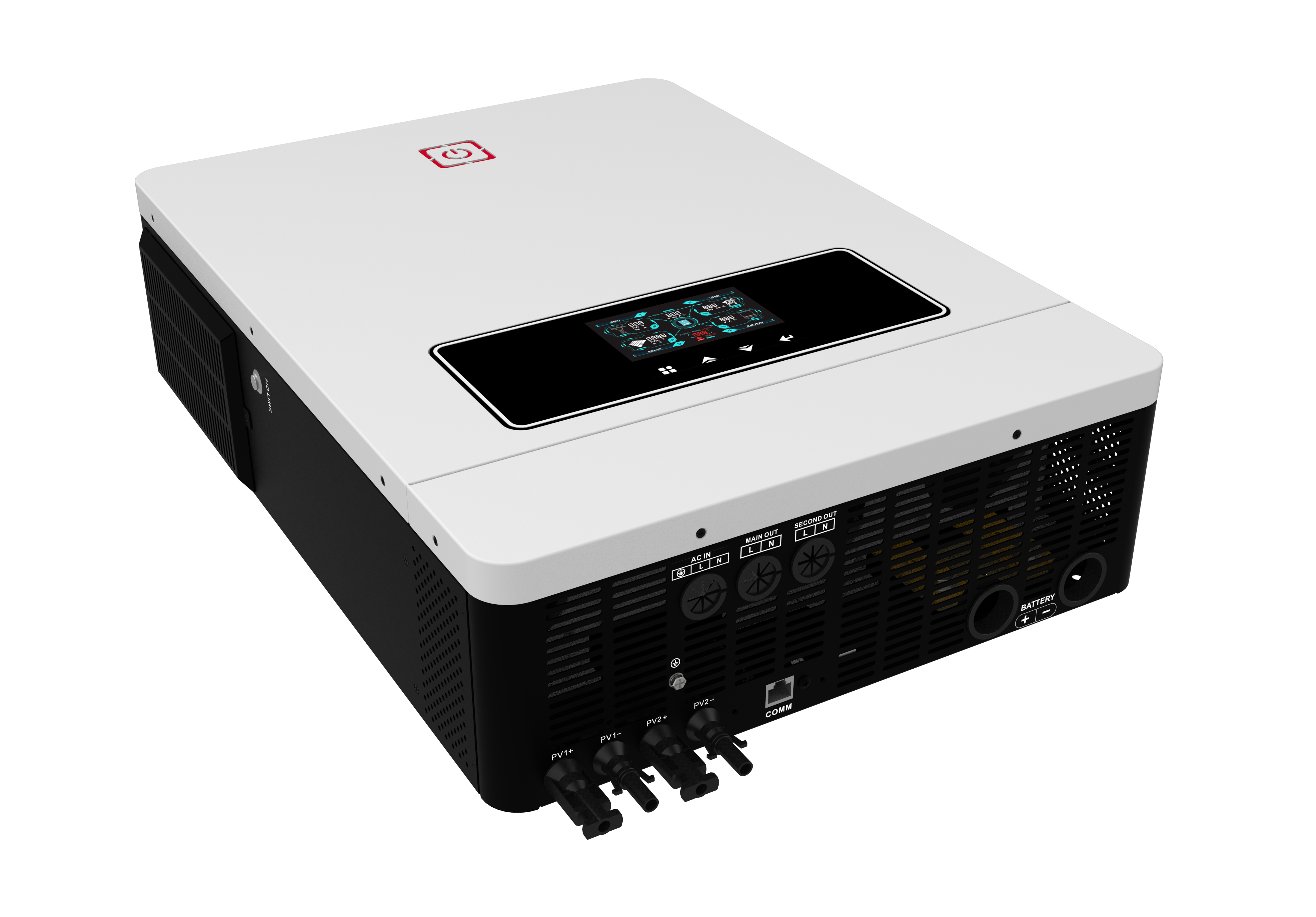
Sizing a home solar inverter requires strict adherence to mathematical formulas. You must calculate the absolute maximum load the system will experience. This ensures the hardware can handle simultaneous appliance startups without dropping the voltage.
The standard formula for sizing is straightforward. You add the sum of all continuous loads to the highest single surge load. You do not need to add all surge loads together. It is highly unlikely that every motor in your house will start at the exact same millisecond. You only need to account for the single largest surge spike happening while everything else is running normally.
| Appliance | Continuous Wattage | Surge Wattage (Peak) |
|---|---|---|
| Refrigerator | 400W | 1200W |
| Well Pump (1/2 HP) | 1000W | 3000W |
| LED Lighting (10 bulbs) | 100W | 100W |
| Wi-Fi Router & Modem | 40W | 40W |
| Microwave | 1000W | 1000W |
| CPAP Machine | 60W | 60W |
Using the table above, the sum of all continuous loads is 2600W. The highest single surge load comes from the well pump. The well pump requires an additional 2000W above its continuous draw to start. Therefore, your total load requirement is 2600W plus 2000W. This equals 4600W. Your inverter must be able to handle at least 4600W to keep this specific critical load panel operational.
You never run an inverter at its maximum capacity continuously. Running hardware at 100% capacity generates excessive heat. This thermal stress degrades internal capacitors, stresses the cooling fans, and shortens the lifespan of the unit. Industry standards require a 20% safety buffer to maintain thermal equilibrium.
To apply this buffer, multiply your total continuous load by 1.2. In our previous example, the continuous load was 2600W. Multiplying 2600W by 1.2 gives you 3120W. This means you need an inverter with a continuous rating of at least 3120W. You also need it to handle the 4600W peak surge. A standard 5000W inverter easily meets both requirements. The buffer protects internal components from thermal stress. It also provides headroom if you add another small appliance to the sub-panel later.
The inverter capacity must align with your physical solar panel array. This relationship is called the DC-to-AC ratio. The DC rating of the solar array should generally exceed the AC rating of the inverter. A ratio between 1.15 and 1.25 is ideal for modern residential setups.
For example, you might pair a 6000W (6kW) solar array with a 5000W (5kW) inverter. This creates a ratio of 1.2. Solar panels rarely produce their maximum rated output in real-world conditions. Dust, shading, wire resistance, and suboptimal weather reduce efficiency. By oversizing the DC array, you ensure the inverter operates closer to its maximum capacity during early mornings and late afternoons. This maximizes total daily energy yield.
This setup occasionally causes inverter clipping. Clipping happens when the solar panels produce more DC power than the inverter can convert to AC. The inverter simply rejects the excess power to protect its internal circuitry. Losing a small amount of peak midday production is an acceptable trade-off. It results in a wider production curve and higher overall system efficiency throughout the rest of the day.
Inverters do not operate at flat efficiency rates. They have an efficiency curve dictated by their internal transformer and switching electronics. Peak efficiency typically occurs when the inverter carries a load between 30% and 70% of its maximum capacity. If you grossly oversize an inverter for a small essential load panel, it will operate at the bottom of its efficiency curve.
An 8000W inverter running a 400W refrigerator operates at just 5% capacity. At this level, the internal power consumption of the inverter itself (tare loss) wastes a significant percentage of the generated electricity. Sizing the inverter correctly keeps the daily operating load within the optimal 30% to 70% efficiency window, ensuring your battery power is used to run appliances, not just to keep the inverter turned on.
Not all inverters provide backup power during a grid outage. You must select the correct architecture to keep essential circuits running safely and legally.
Standard grid-tied string inverters shut down completely during a power outage. This is a strict safety requirement mandated by utility companies. If they continued pushing power into the grid, they could electrocute utility workers repairing the lines. These systems offer zero backup capability, regardless of how much sunlight hits the panels.
Off-grid inverters operate entirely independently of the utility grid. They are not designed to sync with grid power. They rely entirely on solar and batteries. While great for remote cabins, they are impractical for homes that want to use grid power when it is available.
An essential circuit backup system requires islanding capabilities. Islanding allows the system to physically disconnect from the utility grid during an outage using an internal or external transfer switch. Once disconnected, it forms its own microgrid to power your home safely without backfeeding the utility lines.
A residential hybrid power inverter manages inputs from solar arrays, battery storage, and the grid simultaneously. It acts as the central brain of the energy system. When the grid fails, the hybrid inverter automatically islands the home. It then pulls DC power from the batteries and solar panels, converting it to AC power for the critical load panel.
You must choose between DC-coupled and AC-coupled architectures. DC-coupled systems connect the solar panels and batteries directly to the same hybrid inverter. This requires only one conversion from DC to AC. It offers higher round-trip efficiency during battery charging. AC-coupled systems use separate inverters for the solar panels and the batteries. This requires multiple conversions, which slightly reduces overall efficiency but allows for easier retrofitting of existing solar arrays.
The inverter is only one part of the backup equation. You must ensure the inverter's charge and discharge capacity aligns with the battery bank's maximum continuous output rating. Batteries have a C-rate, which dictates how fast they can safely discharge power.
If your inverter can output 5000W, but your battery bank's Battery Management System (BMS) limits continuous discharge to 3000W, you have a bottleneck. During a heavy load spike, the inverter will demand more power than the battery can provide. The BMS will trip, shutting down the entire system. The battery throughput must meet or exceed the inverter's maximum draw to ensure stability during motor startups.
Selecting the right hardware requires looking past the marketing brochures. You must evaluate specific technical dimensions to ensure reliability during an emergency.
Every essential load backup inverter lists a peak surge capacity. However, you must evaluate the duration of these surge ratings. Some inverters can hold their surge rating for 30 minutes. Others can only hold it for 10 seconds. If you have high-draw inductive loads like well pumps or sump pumps, you need an inverter that can sustain the surge long enough for the motor to reach full speed. A 10-second surge rating might not be enough for an older, heavy-duty compressor fighting against high head pressure.
When the grid fails, the inverter must switch from grid power to battery power. This is the transfer time. It is measured in milliseconds. Standard backup systems might take a few seconds to switch over. This causes lights to flicker, clocks to reset, and computers to shut down.
If you run sensitive electronics, medical devices, or home servers, you require UPS-grade reliability. Look for inverters with transfer times under 20 milliseconds. At this speed, the ATX power supplies in desktop computers will bridge the gap. The transition is seamless, and your devices will not reboot.
Inverters generate heat during the DC-to-AC conversion process. Extreme ambient heat reduces an inverter's maximum power output. This is known as temperature derating. If you install the inverter in a hot garage or on a south-facing exterior wall, it will not perform at its rated capacity during the summer.
| Ambient Temperature | Inverter Output Capacity | Impact on a 5000W Inverter |
|---|---|---|
| 25°C (77°F) | 100% | 5000W |
| 35°C (95°F) | 90% | 4500W |
| 45°C (113°F) | 80% | 4000W |
| 55°C (131°F) | 60% | 3000W |
An inverter rated for 5000W at 25°C might only output 4000W at 45°C. You must factor your local climate into the 20% safety buffer. Ensure the inverter can still carry your essential loads during a summer heatwave when ambient temperatures peak and cooling fans struggle to dissipate internal heat.
Your power needs may grow over time. You might add a medical device, upgrade to a larger refrigerator, or install a secondary freezer. Assessing whether the inverter allows for parallel stacking is critical. Parallel stacking allows you to wire a second identical inverter into the system later. They communicate via specialized communication cables to synchronize their AC output waveforms. This doubles your continuous and surge capacity without requiring a complete system replacement.
Designing a backup system involves balancing performance against installation costs. You must navigate specific implementation risks to ensure a successful deployment.
Undersizing the inverter relative to the solar array saves upfront capital. However, it increases inverter clipping. You must model these clipping losses against the initial savings. If you clip 5% of your annual production, calculate the value of that lost energy over a 10-year period. In most cases, a slight undersize makes financial sense because the extra energy generated in the morning and evening outweighs the midday clipping. Extreme undersizing, however, wastes too much potential solar generation and stresses the inverter.
Rewiring essential circuits from the main breaker to a dedicated sub-panel requires significant labor. An electrician must physically pull the hot wires out of the main panel and route them to the new critical load panel. This process involves hardware costs for the new panel, breakers, and conduit.
Code compliance is a major factor. The National Electrical Code (NEC) dictates strict requirements for sub-panel clearances, grounding, and neutral bonding. When moving a circuit to a sub-panel, you must move both the hot wire and the neutral wire. Leaving the neutral in the main panel creates a dangerous ground loop. Furthermore, the neutral bus bar in a sub-panel must float; it cannot be bonded to the ground like it is in the main service panel. Improper neutral bonding creates severe shock hazards. Always hire a licensed professional for this phase of the installation.
Evaluate warranty terms carefully. Standard warranties range from 10 to 25 years. Read the fine print to understand what voids the warranty. Improper sizing, poor ventilation, failing to install surge protection, or installing an indoor-rated unit outside will void your coverage immediately.
Ensure the equipment meets local grid interconnection standards. Inverters must comply with IEEE 1547 and UL 1741 SA/SB. These certifications guarantee the inverter has the smart grid support functions required by modern utility companies, such as voltage ride-through and frequency regulation. Failing to meet these standards will result in a failed inspection. The utility company will refuse to connect your system to the grid.
Sizing a home solar inverter for essential circuits is a strict mathematical exercise. It requires a precise calculation of continuous loads and a realistic assessment of inductive surge requirements. You must also implement a strategic DC-to-AC ratio that aligns with your solar panel array. Balancing these factors ensures reliable power during grid failures while maintaining high daily efficiency.
For most essential load applications, prioritize residential hybrid power inverters in the 5000W to 8000W range. These units offer the necessary surge durations, sub-20ms transfer times, and parallel scalability required for modern homes. They provide a robust foundation for long-term energy resilience.
Take the following steps to finalize your system design:
A: If undersized, the inverter will overload and shut down when multiple appliances run simultaneously or when a high-surge device starts. This trips the internal protection circuits, leaving you without power during an outage.
A: Yes, a 5000W inverter can typically handle these loads. The combined continuous wattage must remain under 4000W to leave a 20% buffer. The inverter's peak surge rating must also handle the simultaneous startup of the well pump and refrigerator compressors.
A: The DC rating of your solar panel system should be slightly larger than your inverter's AC rating. Pairing a 6kW solar array with a 5kW inverter achieves an ideal 1.2 DC-to-AC ratio, maximizing efficiency without overloading the system.
A: The industry standard is a ratio between 1.15 and 1.25. The solar panel array's DC output is 15% to 25% larger than the inverter's AC capacity. This maximizes power generation during low-light conditions while accepting minimal clipping at peak sun.
A: Yes. A critical load panel physically isolates your essential circuits from heavy, non-essential loads like electric heaters or AC units. This ensures your inverter and battery are not drained or overloaded during a grid failure.
A: Surge wattage dictates the absolute peak power the inverter must deliver for a few seconds to start electric motors. If your continuous load is 3000W but your well pump requires a 4000W surge to start, your inverter must have a surge rating of at least 7000W.