
 English


Views: 0 Author: Site Editor Publish Time: 2026-09-26 Origin: Site


A photovoltaic inverter is an electronic device that converts the direct current (DC) electricity from solar panels into usable AC electricity. Think of it as the brain of your solar system. It manages the conversion, optimizes output, and keeps everything running safely. This component makes solar energy usable for your home and the grid.
The inverter is the essential part of the photovoltaic system. Without it, you cannot use the power from your panels. The inverter's purpose extends beyond conversion. It also monitors performance, protects against faults, and maximizes your pv array's output.
Modern inverters perform this function automatically. They track the maximum power point to boost energy harvest. These inverters also manage pv current flow and grid compliance.
A photovoltaic inverter changes direct current from solar panels into usable alternating current.
The inverter monitors your system's performance and protects against grid faults.
Maximum Power Point Tracking (MPPT) helps your panels produce more energy.
String inverters work well for simple roofs; microinverters handle shade better.
Match inverter size to your solar array and follow local electrical codes.
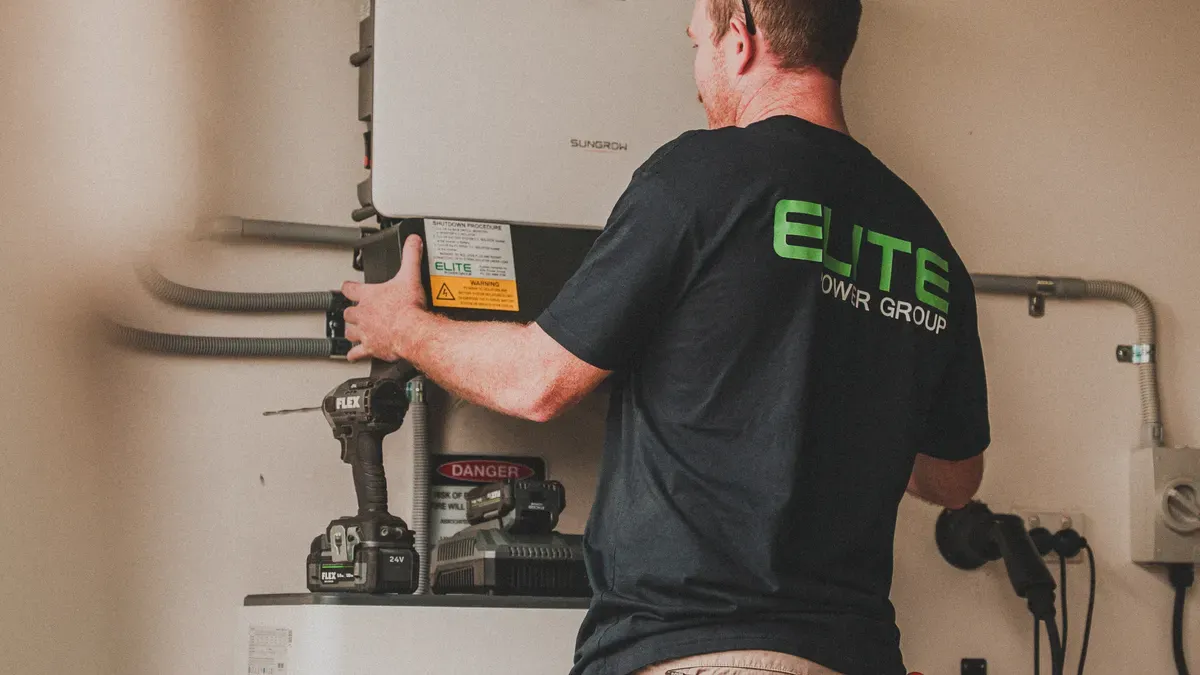
Image Source: pexels
A photovoltaic inverter is a critical component that converts variable DC output into grid-compliant AC. You may hear experts call it the brain of the solar system. This label fits because the inverter manages conversion and provides oversight for the entire array. The definition stays simple: it changes the direct current generated by the PV modules into the alternating current needed by domestic appliances.
The conversion process starts when your solar panel produces direct current. This direct current flows into the inverter. Electronic switches inside the device, such as transistors or MOSFETs, rapidly control the current flow. This action generates a series of pulses. The inverter then varies the width of each pulse to simulate a sinusoidal waveform. This technique is called pulse width modulation. The pulsed output passes through a filter circuit to smooth the waveform and remove high-frequency noise. Transformers may also adjust voltage to match AC grid standards.
The DC input is switched thousands of times per second. The resulting pulses combine into a sinusoidal output matching grid voltage and frequency. Filters then smooth the waveform before it is fed into the grid. This method delivers high-quality AC conversion, output voltage and current control, reduced harmonic distortion, improved efficiency, and stable grid synchronization.
A grid-tied photovoltaic inverter differs from a conventional inverter in key ways. The table below shows these differences.
Aspect | Grid-Tied PV Inverter | Conventional Inverter |
|---|---|---|
Frequency & output voltage | Synchronizes frequency and output voltage to the connected grid | Cannot synchronize with the grid |
AC waveform matching | Accurately matches phase and voltage of the grid's sine wave AC waveform | Does not perform grid waveform matching |
Operational intelligence | Has processing intelligence to determine when power delivery is needed and syncs grid power with power delivery | Functions alone and does not coordinate with grid power |
Connection target | Works alongside the mains/grid to deliver energy where needed | Connects only to appliances in the house |
PV systems need inverters because homes and businesses run on alternating current. The AC output from your inverter must match specific standards. For residential systems, typical DC input voltage maxes out at 600V, capped by NEC 690.7(C) for one- and two-family dwellings. The operating range usually falls between 500V and 600V. Actual array Voc, cold-corrected, must stay below the 600V threshold. On the AC side, you will see 120V, 208V, or 240V. The dominant standard for standalone homes is 240V single-phase. Nearly all inverters above 3 kW use this voltage.
Grid connection standards also shape the inverter's function. IEEE 1547-2018 defines comprehensive technical and interoperability requirements for interconnecting DERs, including solar PV, with Area Electric Power Systems. This standard covers performance metrics, ride-through, communications, testing, and safety. It applies to DERs up to 10 MVA. UL 1741 SB ensures DERs meet the ride-through and communication requirements of IEEE 1547-2018. IEEE 519 defines harmonic distortion limits that DERs must comply with to avoid degrading local power quality.
Inverter manufacturers choose which Supplement (SA or SB) to certify their equipment to as they deem appropriate and as the market requires. The intention of the Supplement SB revision document is to result in a common understanding and application of the new requirements to maximize consistency in DER response to grid events.
The conversion process matters because it determines whether your solar power can actually power your lights, appliances, and electronics. Without proper conversion, the direct current from your panels remains unusable for your home.
Beyond the basic conversion, a photovoltaic inverter also controls and monitors the solar power system. It optimizes performance and ensures safety. The main function of an inverter goes far past changing direct current into alternating current. You will find that these devices act as the central manager for your entire array.
Maximum Power Point Tracking, or MPPT, is the function of the inverter that squeezes the most power from your pv modules. The inverter continuously adjusts the operating point of your solar modules to track the maximum power point. This point changes with irradiation and temperature. The inverter uses an electronic control system with a DC/DC converter to vary the load. This keeps the product of current and voltage at its peak. Algorithms allow real-time tracking with rapid adjustments. Compared to PWM controllers, MPPT can extract more energy. In practice, MPPT increases energy yield depending on location, weather, and system configuration.
Global MPPT refers to an inverter's ability to sweep the array's I-V curve within its operating voltage limits. This finds the global maximum power point. Most modern residential inverters support global MPPT because shading from trees and obstructions is common. Large commercial and central inverters may not include this functionality because significant shading is generally not expected. Traditional solar inverters perform MPPT for the entire array. The same current dictated by the inverter flows through all modules in a series string. Because different modules can have different I-V curves and different MPPs due to manufacturing tolerance or partial shading, array-level MPPT can cause some modules to operate below their MPP. This reduces efficiency. MPPTs can instead be deployed for individual modules. This allows each module to operate at peak efficiency despite uneven shading, soiling, or electrical mismatch.
Modern photovoltaic inverters are equipped with built-in monitoring capabilities. They connect to a local network or the internet. This enables remote performance tracking through a web portal or mobile app. This digital monitoring delivers real-time data on energy production, system performance, and potential issues. It helps you ensure optimal operation and detect anomalies or performance drops. Most inverters feature physical indicators such as display screens or LED lights. These show operational status, fault conditions, and performance metrics. You can quickly diagnose issues without advanced technical knowledge.
Safety is another critical role. Anti-islanding protection is a commonly required safety feature. It disables PV inverters when the grid enters an islanded condition. This protection is required for UL1741 / IEEE 1547. According to IEEE 1547 section 4, an Area EPS must be de-energized within two seconds of the formation of an island. Passive anti-islanding protection monitors voltage and frequency. Active anti-islanding protection varies reactive power output to help destabilize the island and accelerate its dissolution. Grid-connected inverters continuously monitor grid voltage and frequency to detect abnormalities indicating grid outage or instability. When abnormalities are detected, the inverter immediately disconnects from the grid to prevent independent operation. This protects utility workers from hazardous energized lines and prevents islanded operation that could destabilize the electrical grid.
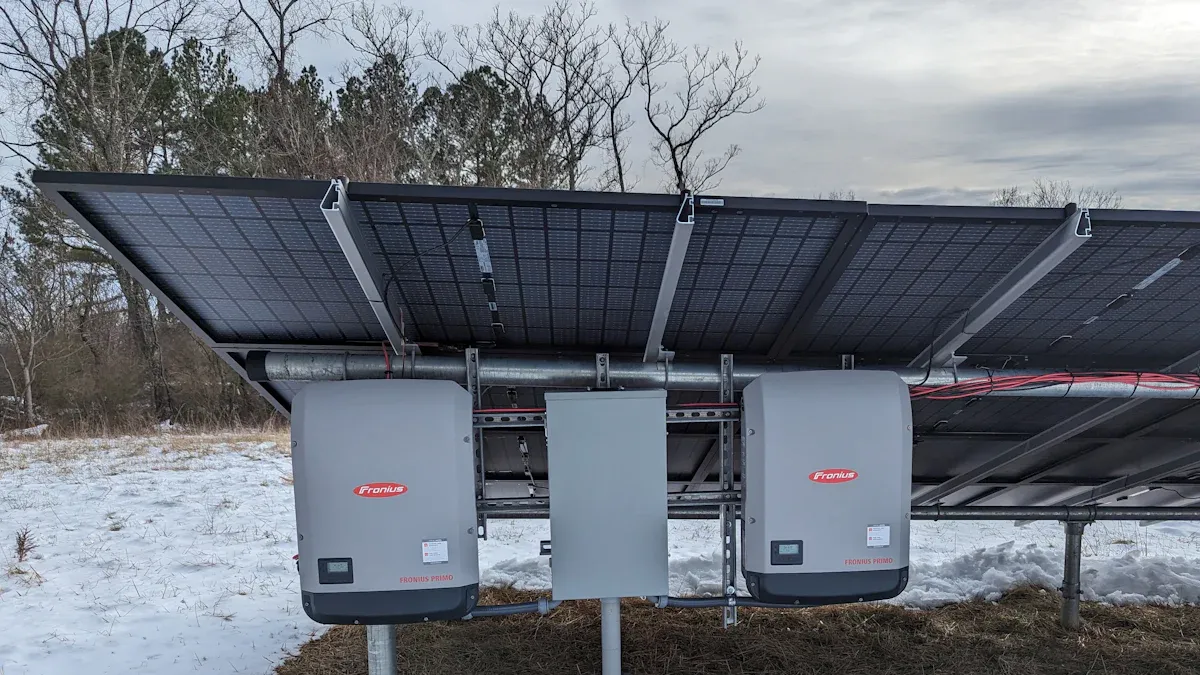
Image Source: unsplash
You will find several designs on the market today. Each type suits a different roof layout, budget, and energy goal. The three primary categories are string inverters, microinverters, and hybrid inverters. A fourth type, the central inverter, serves utility-scale plants.
A string inverter connects multiple pv modules together in series. This design combines high-voltage direct current before conversion. One underperforming solar panel drags down the whole string, because the same current flows through every module. A microinverter solves this problem. It mounts underneath each panel and converts DC to AC at the source. Each unit performs maximum power point tracking independently, so shade or dirt on one panel does not reduce the output of the rest.
The table below compares these two options.
Inverter Type | Advantages | Disadvantages |
|---|---|---|
String Inverter | Low cost; simple design; easy to troubleshoot | One error impacts the entire system; difficult expansion; short lifespan |
Microinverter | Independent panel performance; built-in monitoring; easy expansion; 25-year warranty | Difficult to repair; expensive; more points of failure |
Cost often decides the choice. A 10 kW string system carries an installed inverter cost of $1,500 to $2,500. A microinverter system of the same size adds $0.30 to $0.50 per watt, or roughly $3,000 to $5,000 more. After the 30% federal ITC, the gap narrows to about $2,100 to $3,500. String inverters also carry shorter warranties, around 12 years versus 25 years, and typically need replacement near year 13 at a cost of $1,500 to $3,000 with labor. Over a full 25-year life, microinverters can reach cost parity for most installations, especially where shade is common.
A hybrid inverter merges solar generation, battery storage, and grid power into one unit. It converts DC to AC for your home and can convert AC from the grid back into DC for battery charging. This bidirectional function gives you backup power during outages and greater energy independence. The device also regulates variable solar output and tracks maximum power points to maximize charging efficiency. Modern solar-plus-storage systems increasingly favor this design.
Central inverters handle a different scale entirely. They use a high-power-density, centralized architecture and process power from thousands of panels. These units are built for megawatt-level conversion. Utility-scale projects are the most common application today. Large commercial and smaller utility projects from just a few years ago also rely on them. A central inverter delivers substantial economies of scale, which explains its dominance in the utility market.
Your choice among these types shapes performance, cost, and future expandability. A shaded roof with multiple orientations points toward microinverters. A clear roof with a tight budget favors a string design. Plans for battery backup make a hybrid unit the practical pick.
Sizing starts with the relationship between your array and the inverter. The DC-to-AC ratio, also called the inverter load ratio, expresses how much solar panel capacity connects relative to the inverter's AC output. Since pv modules rarely reach rated peak output simultaneously, the array's nominal capacity typically exceeds the inverter capacity by at least 10%. A ratio of 1.1 to 1.3 is considered healthy for residential applications. Ratios above 1.5 risk frequent clipping, where the panels produce more power than the inverter can handle.
To calculate this ratio, multiply the number of panels by their maximum output in watts to get DC size. Then multiply the number of inverters by their peak output to get AC size. Divide DC by AC to find your ratio. For regions with partial shading or frequent cloudy days, a ratio of 1.25:1 works well. This ensures inverters operate near full potential without unnecessary expense.
Factor | Explanation |
|---|---|
DC-to-AC ratio | Array sized slightly higher than inverter rating; 1.1 to 1.3 is healthy |
Grid regulations | Local rules may restrict AC capacity fed into the grid |
Surge currents | Add roughly 50% more capacity for startup surges |
MPPT capacity | Must be sufficient to interface with your pv modules |
Your home's electrical service determines which inverter type you need. Single-phase inverters require a single-phase supply with two wires: active and neutral. Three-phase inverters need four wires: three active and one neutral. Most new homes use single-phase power. Larger homes and older properties often have three-phase service. For single-phase homes, maximum inverter size is typically 5kW, though this varies by state. Three-phase homes face no strict limit, but installations over 5kW often need case-by-case approval.
Regional codes shape your installation. The National Electrical Code, or NEC, serves as the primary code for PV systems. NEC Article 690 covers solar photovoltaic systems and includes rapid shutdown requirements. NEC Article 705 addresses interconnected power production sources and affects where inverters connect relative to your main service disconnect. Fire codes also impact physical layout. The International Fire Code requires perimeter pathways on roofs. These rules vary by location, so consult your local authority before finalizing your design.
A photovoltaic inverter changes direct current into alternating current. This device also acts as the brain and heart of your system. It tracks performance, manages safety, and maximizes power output every day.
Your choice among inverter types shapes performance, cost, and future expandability. String inverters, microinverters, and hybrid units each serve different needs. A hybrid model supports battery storage later. A string design saves money now.
Consult a certified installer. That expert evaluates your roof layout, shading, and energy goals. Proper sizing prevents problems.
Now that you understand what a photovoltaic inverter is and how it works, you're ready to make an informed decision for your solar journey.
String inverters typically need replacement around year 13. If your system loses power output or displays fault codes, check your inverter. You may need a new unit to restore full pv production.
Shading on one panel reduces current for the entire string when using string inverters. Your system power drops because the inverters cannot optimize each panel independently. Microinverter designs avoid this.
Maximum Power Point Tracking adjusts your pv panels' operating point. It extracts the most power possible under varying sunlight and temperature. Your system gains more energy compared to designs without MPPT.