
 English


Views: 0 Author: Site Editor Publish Time: 2026-09-25 Origin: Site


Think of a photovoltaic inverter as the brain of your solar system. Solar panels make DC power, and this device turns that DC power into AC power your home can use. Without it, your panels cannot run your lights, fridge, or computer.
Choosing the right inverter matters more than any other decision. It shapes system safety, efficiency, and long-term energy production. Inverter inefficiency costs real energy. A 5 kW array that generates 7000 kWh per year, paired with a 95% efficient inverter, delivers only 6650 kWh of usable AC energy. That 350 kWh loss equals several weeks of household electricity.
This guide walks you through a clear, step-by-step process. You will learn about inverter types, key selection factors, sizing, and practical buying checks for a solar inverter for your home.
Choose the right inverter type for your roof and budget.
Calculate your energy needs to size the inverter correctly.
A DC-to-AC ratio between 1.1 and 1.4 works for most homes.
Check grid compliance and warranty for long-term safety.
Monitor your system to catch problems early and save energy.
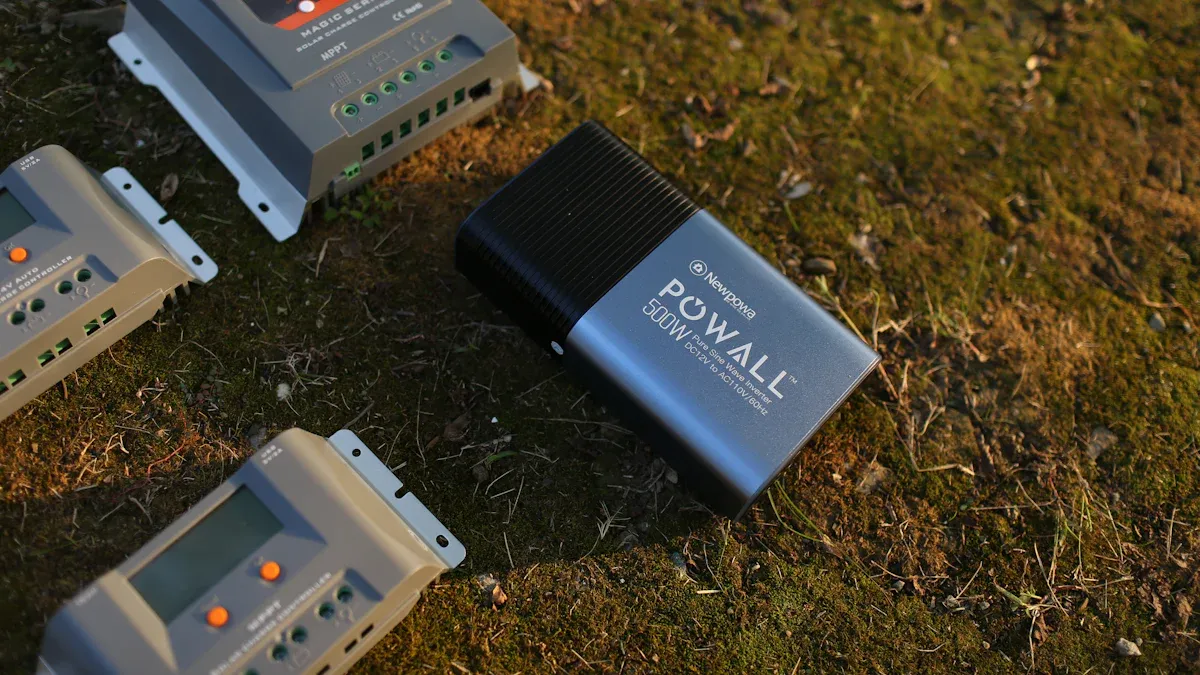
Image Source: unsplash
You will encounter several main types of solar power inverters on the market today. Each design serves a different roof layout, budget, and energy goal. Understanding these differences helps you pick the right type for your home.
String inverters remain the most cost-effective choice for uniform, unshaded arrays. They connect a series of panels into one or more strings and convert the combined DC output to AC. However, you must calculate string voltage carefully. Panel voltage changes with temperature, and cold mornings push voltage higher. The National Electrical Code 690.7 provides a chart for temperature-corrected open-circuit voltage. You can also calculate it using the module's temperature coefficient of voltage and the coldest local temperature. This correction prevents cold-temperature voltage rise from damaging your solar inverter. A common rooftop panel produces between 20 and 40 volts. When you connect panels in series, their voltages add together. Two 20 V panels yield 40 V, and three yield 60 V. The cold-weather open-circuit voltage formula is V_cold = V_oc,STC × [1 + |β_Voc| × ΔT]. For a module with 45 V Voc and a voltage coefficient of -0.30%/°C, a 35°C drop below 25°C gives 49.73 V. Ten panels in series produce 497.3 V. This value must stay below your inverter's maximum DC input voltage.
Power optimizers add module-level optimization to a string inverter. They suit partially shaded roofs where one panel's shade would otherwise drag down the whole string. This middle-ground solution costs more than a plain string inverter but less than full microinverter systems.
Solar microinverters optimize each panel individually. They work best on complex roofs with shading or multiple orientations. Field data shows solar microinverters have a failure rate of less than 1 in 800 in the first two years. String inverters show approximately 1 in 350 in the same period. Over ten years, string inverters fail at 5–15%, while microinverters fail at 0.05% per unit per year. This reliability gap matters for long-term ownership.
In many partially shaded installations, microinverters can increase annual energy production by 5% to 25%, depending on roof conditions.
Hybrid inverters serve homeowners who want battery storage, backup power, and energy independence. They combine a solar inverter and battery charger in one unit. This inverter type lets you add batteries now or later without replacing your original equipment.
The table below compares all four options.
Inverter Type | Pros | Cons | Best Use |
|---|---|---|---|
String | Lowest cost, simple design | Shade sensitivity, high voltage risk | Uniform, unshaded arrays |
Power Optimizer | Module-level optimization, string benefits | Higher cost than string | Partially shaded roofs |
Microinverter | Per-panel optimization, high reliability | Highest upfront cost | Complex roofs, multiple orientations |
Hybrid | Battery-ready, backup power | Higher cost, complex setup | Energy independence goals |
Your choice among types of solar inverters depends on your roof and your plans. A solar system with uniform sun and a tight budget points to string inverters. A solar system with shade and complex angles favors solar microinverters. If you want backup power, a hybrid unit is the clear answer.
Start by calculating your home energy consumption. List every major device and its wattage. A refrigerator draws approximately 300–800 W and runs continuously. A central air conditioner typically uses 3,000–5,000 W. A pool pump adds 750–2,500 W. Multiply each wattage by daily run hours to get kilowatt-hours.
Your location also shapes demand. A 2,000-square-foot home in coastal Los Angeles uses 18–28 kWh per day. The same home inland uses 28–42 kWh per day. These figures determine your solar panel system size and the solar inverter for your home.
Roof orientation, tilt, and space matter too. South-facing panels perform best when tilted between 15° and 40°, according to the U.S. Department of Energy. A 10° tilt error reduces output by about 1.5%. Limited roof space may push you toward higher-efficiency panels and a compact home solar inverter.
Shading patterns favor module-level power electronics. If a chimney or tree shades part of your roof, string solar inverters drag down the whole array. Microinverters or power optimizers isolate each panel. This choice protects your solar system output.
Budget trade-offs deserve honest review. Inverters and electrical work make up roughly 10% of total system cost. Labor adds another 10%. A 12 kW system averages about $30,000 before incentives. Spending more on a right inverter now can reduce replacement costs later.
Think about future expansion. Do you plan to add batteries or more panels? A hybrid unit lets you add storage without replacing equipment. This flexibility makes it the right solar inverter for homeowners seeking energy independence. Choose solar inverters that match your five-year plan, not just today's needs.
Image Source: pexels
Sizing ties every earlier choice together. A unit that is too small wastes panel output. A unit that is too large wastes your money. The dc-to-ac ratio gives you a single number to judge the match.
The dc-to-ac ratio compares your array's rated DC power to the inverter's AC output rating. Divide array watts by inverter watts. A 6,000 W array with a 5,000 W inverter gives a dc-to-ac ratio of 1.2. Grid-tied systems typically run between 1.1 and 1.4. This range is normal and intentional.
A dc-to-ac ratio above 1.0 means your panels can produce more than the inverter converts at peak sun. The inverter clips the excess. Slight clipping is deliberate. Panels rarely hit their rated output, so a modest dc-to-ac ratio keeps the inverter busy on ordinary days. Excessive undersizing changes the math. A dc-to-ac ratio far above 1.4 clips real energy you paid for.
Oversizing the inverter creates the opposite problem. A dc-to-ac ratio well below 1.0 leaves capacity unused. You pay for silicon that never works. Match solar inverter capacity to your actual array, not to a future array you may never build.
Efficiency ratings decide how much DC power survives the trip to AC. Peak efficiency describes the best-case number. CEC weighted efficiency reflects real-world performance across varying loads. Look for ratings above 96%. The table below shows two popular models.
Inverter Model | CEC Weighted Efficiency |
|---|---|
SMA Sunny Boy 7.7-US-41 | 97.0% |
Fronius Primo GEN24 (6.0 / Plus) | ~97.6–97.9% (varies by model) |
GEN24 models post CEC weighted efficiencies around 97.6–97.9% against the Sunny Boy's 97.0%.
That gap looks small. Over a decade of production, it adds up. Higher efficiency lifts solar energy system efficiency and shrinks losses.
Good inverter sizing starts with your array's DC rating and your roof's realistic output. Use the dc-to-ac ratio as your guide. Aim for the 1.1 to 1.4 band on grid-tied systems. This approach lets you right size inverter hardware without guesswork.
Off-grid and hybrid systems add a second constraint. These units are built around a specific nominal DC battery voltage. The 48V level is the most common choice. It aligns well with most lithium battery systems, which are typically 48V. Smaller-capacity inverters often use 12V or 24V and must pair with battery banks of the same voltage. High-end 48V hybrid and off-grid inverters come from brands such as Selectronic, SMA, and Schneider. Victron Energy and Outback Power offer 12V, 24V, and 48V options. Higher-voltage battery systems (150–500V) are becoming more common for grid-tied home storage. Some hybrid inverters support them, but they are model-specific and not universal.
Voltage choice affects current and wiring. The same load draws different amperage at each level.
4000W at 12V requires 333 Amps
4000W at 24V requires 166 Amps
Higher voltage means lower current, thinner cables, and less resistive loss. A 48V solar inverter also matches the charge controller type to the battery bank. Always confirm the dc-to-ac conversion ratio and the dc to ac conversion ratio your equipment supports before you buy. The dc-to-ac ratio governs grid-tied matching. The dc to ac conversion ratio and battery voltage govern hybrid matching. Check both, and your photovoltaic inverter will serve the solar system for years.
Before you sign a contract, run through a few practical checks. These steps protect your investment and confirm your equipment will work with your local grid.
A grid-tied inverter must follow your utility's rules. These rules cover power quality, voltage ranges, and safe shutdown during outages. Anti-islanding protection is the key safety feature. It stops your inverter from feeding power to the grid when the utility goes down. This protection keeps line workers safe.
The IEEE 1547-2018 standard sets the testing path for this function. Labs verify anti-islanding through open circuit tests, load rejection tests, and non-detection zone analysis. Ask your installer for proof of compliance.
Certification matters too. UL 1741 is the core safety standard for inverters in North America. It covers both equipment safety and grid interaction. IEC 62109 provides the international benchmark. IEC 62109-1 covers general safety, and IEC 62109-2 adds inverter-specific functions like insulation monitoring and ground fault protection. A solar inverter without these marks is not ready for your home.
Modern solar inverters ship with monitoring built in. Wi-Fi or cellular links track output in real time. Good platforms flag problems fast. A communication dropout should trigger within 4 hours. Production more than 20% below the modeled baseline should alert the same day. A single optimizer or microinverter offline should surface within 24 hours. A grid fault should alert immediately. A performance ratio below 75% over a rolling 7-day window points to a systemic issue. Enphase Enlighten and SolarEdge monitoring both support configurable email alerts out of the box.
Heat shortens inverter life. Check the operating temperature range and the cooling method. Passive cooling suits mild climates. Active cooling with fans handles hot climates better. Warranty terms vary by brand. Enphase microinverters carry 25 years. SolarEdge string inverters carry 12 years, with 20 or 25 year extensions. SMA offers 10 years, extendable to 15 or 20. Extended warranties add years of product coverage. They rarely cover labor, shipping, or external damage. Communications equipment usually caps at 5 years. Buy from a manufacturer with a strong service reputation. That choice protects your solar inverter performance for decades.
The journey starts with the types of solar inverters available today. Your choice depends on your roof and budget. Next, evaluate shading patterns and future plans. Third, sizing ties everything together. The dc-to-ac ratio tells you if your inverter size matches your array. A ratio between 1.1 and 1.4 works for most grid-tied systems. Fourth, check grid compliance and warranty terms. The dc-to-ac ratio guides your final decision.
The right solar inverter fits your unique energy needs, roof layout, and budget. Different solar power inverters suit different situations.
Use this guide as your checklist when requesting quotes. Ask about efficiency ratings above 96%, monitoring features, and warranty length. Choose your inverter carefully.
String inverters typically last 10–15 years. Microinverters can last 25 years or more. Enphase microinverters carry 25-year warranties. SolarEdge string inverters offer 12 years, extendable to 25. Plan for at least one inverter replacement during your system's life.
Yes, if you choose a hybrid inverter now. Hybrid units combine a solar inverter and battery charger in one device. They let you add storage later without replacing equipment. Standard string inverters do not support direct battery connection.
Clipping happens when your solar panels produce more DC power than your inverter can convert at peak sun. A DC-to-AC ratio between 1.1 and 1.4 is normal. Slight clipping keeps your inverter working efficiently on ordinary days.
Monitoring tracks your system output in real time. Most modern inverters include Wi-Fi or cellular connectivity. Good platforms flag problems quickly, such as production dropping more than 20% below baseline or a single microinverter going offline for 24 hours.